Most destination advice starts in the wrong place. It hands you a list of ten beautiful cities and lets you sort it out from there, which is how people end up booking a trip that photographs beautifully and exhausts them by day three.
I’ve come around to a different approach. Answer eight questions about yourself — who’s coming, how long you have, what your body and your budget will actually tolerate — and the destination mostly picks itself. The map narrows on its own.
Answer these quickly and honestly. Your gut answer is the useful one. Aspirational answers are how you end up with a rental car in a medieval old town at 9pm looking for parking.
Two notes before we start. Each answer below points at a type of place first and names examples second — the type is the part that matters, because it’s what lets you apply this to somewhere I’ve never mentioned. And where a place is linked, I’ve been there and written about it. My travel skews European, so that’s where the first-hand recommendations cluster; everywhere else is a starting point for your own research rather than a personal endorsement.
1. Who’s actually coming?
This decides more than anything else on the list, and it’s the question people skip fastest.
- Just me. You can optimize entirely for your own pace, which is a genuine luxury. Look for a walkable city with a good café culture, where sitting alone with a book at dinner is completely normal, and where you feel comfortable walking back to your hotel after dark.
- Me and one other person. The easiest group size there is. Two people can abandon a plan at 2pm and go sit by a canal instead. You can afford a more ambitious itinerary because you can course-correct without a committee.
- A small group of adults. Decision fatigue becomes the real enemy — not distance, not budget. Pick one base, agree in advance that splitting up for an afternoon is normal and not rude, and book dinners ahead so nobody’s standing on a corner at 7pm negotiating.
- Mixed ages, mixed paces. The trip runs at the pace of whoever is most tired, most overheated, or most footsore. That’s not a compromise, it’s just physics. Choose a place where doing less is still worth doing — a town where the sitting-and-watching is as good as the sightseeing.
- Solo → a dense, transit-rich city where a table for one is unremarkable. Amsterdam, Copenhagen, Edinburgh, Lisbon, Tokyo, Montreal.
- Mixed group → a mid-size base with rail service out to smaller places, so the fast people and the slow people can split the day and reconvene at dinner. Luxembourg City, Strasbourg, Kyoto, Salzburg, Santa Fe.
- Probably skip: Multi-stop rail loops with a big group, remote stays where one restaurant serves everyone, and anywhere the day hinges on a single strenuous activity everyone has to be up for.
Our summer trip through Belgium, Luxembourg, Alsace, and Switzerland was five travelers, and that number is exactly why we structured it as a few multi-night bases with day trips out, rather than a new hotel every night. Five people packing and unpacking daily would have been the whole vacation.
2. How many days do you really have?
Not the number on your time-off request. Subtract the flight over, subtract the flight back, and subtract most of your first day on the ground, because a long-haul arrival day is for showering, walking slowly, and eating an early dinner. Whatever’s left is your actual trip.
- Under 5 usable days. One city. No day trips, or one at most. Fly into the place you actually want to be.
- 5 to 8 usable days. One base, two or three day trips out from it. This is the sweet spot for a first international trip, and it’s far more restful than it sounds.
- 9 to 14 usable days. Two or three bases in one region, three nights minimum each. Now a multi-country or cross-country loop is realistic.
- Two weeks or more. You can add a genuine rest day in the middle. Do it. A day with nothing on it is what keeps week two from feeling like a chore.
- Short trip → one city, direct flight, no time lost to jet lag. Domestically that means Charleston, New Orleans, Savannah, Montreal, or Quebec City. Overseas, the ones with the most direct routes: Dublin, Amsterdam, Lisbon, Edinburgh, Reykjavík.
- 9 to 14 days → one region, a few bases, short hops between them. A Belgium-to-Alsace-to-Switzerland run like ours, a Tokyo–Kanazawa–Kyoto line, Portugal end to end, or a Utah national parks loop.
- Probably skip on a short trip: Anything requiring an internal flight, Scandinavia end to end, London-and-Paris-in-five-days, and Japan — which deserves more than a long weekend after a flight that long.
My one hard rule: three nights per base. Two nights means one full day, because arrival afternoon and departure morning don’t count. The math is brutal and it’s why so many itineraries feel like a scramble.
3. What are your limitations — honestly?
This is the question I want you to answer least aspirationally of all. Limitations aren’t a smaller trip. They’re a filter, and the trip that comes out the other side is usually better than the one you’d have picked without them.
- Terrain. Cobblestones, hills, and stairs are the three things that quietly wreck a travel day. Luxembourg City’s lower town is gorgeous and climbing back out of it is genuinely brutal — there’s a free public elevator, and knowing that in advance is the difference between a good day and a bad one. Ask whether the place you’re eyeing is flat.
- Heat. Air conditioning is not a given in European hotels, restaurants, or trains, and humidity does its own damage elsewhere. If you run hot, midsummer in a stone city is a real risk, not a minor inconvenience. Here’s how I handle it.
- Food and digestion. If you have IBS, celiac, allergies, or you just know your system, this belongs in the destination decision and not only in the packing list. I research bathrooms, breakfast options, and pharmacy access before I book, not after.
- Sleep. If you sleep badly in noise, a room over a nightlife street in a busy city center will cost you the whole trip. It’s worth paying more for a quiet side street.
- Energy. Be honest about how many hours a day you actually want to be out. Four good hours beats nine mediocre ones.
- Terrain limits → flat, compact, and well served by trams, buses, or a metro when you’re done walking. Amsterdam, Bruges, Ghent, Colmar, Copenhagen, Kyoto, Chicago, Washington DC.
- Heat-sensitive → go north, go coastal, or go up. Switzerland, Scotland, Norway, the Pacific Northwest, coastal Maine — or anywhere southern in April, May, or October instead of July.
- Probably skip: Hill towns and stair cities. Lisbon’s Alfama, Edinburgh’s Old Town closes, Cinque Terre, Dubrovnik, Santorini, Tuscan hilltop villages, and San Francisco are all beautiful and all vertical. Add Japan in August, which is punishingly humid, and anywhere your main sight is a long uphill walk with no alternative transport.
4. What’s the budget, and which part of it can flex?
A number by itself doesn’t help you pick. What helps is knowing which of the four buckets you’re willing to stretch: getting there, sleeping, moving around once you’re there, and eating.
- Flights are the constraint. Let the cheap route pick the region, then build the trip around wherever you can land affordably. This is the single biggest lever there is.
- Lodging is the constraint. Fewer bases. Every hotel change costs you a night’s rate and a half-day of logistics. A hotel with breakfast included saves real money and, more importantly, saves a decision every single morning.
- Daily spending is the constraint. This is where the choice of country matters enormously.
- Money is not the constraint, time is. Buy the direct flight, buy the private transfer for the ugly leg, buy the hotel with the good location. Convert money into hours and energy.
- Tight daily budget → somewhere the everyday costs are low, not just the flight. Portugal, Poland, Czechia, Hungary, much of Germany, Mexico. Japan belongs here too, which surprises people — the food and the trains cost far less than the airfare suggests.
- Budget can flex → the places that are worth it and will charge you for it. Switzerland, Norway, Iceland, Hawaii. Go in knowing a casual lunch in Zurich costs what a nice dinner costs elsewhere.
- Probably skip on a tight budget: Switzerland, Iceland, Scandinavia, Hawaii — not because you can’t do them, but because the constant math will follow you around all week. Same for Paris, London, Amsterdam, and New York in peak season, where lodging alone eats the plan.
Shoulder season deserves a mention here because it moves every bucket at once — cheaper flights, cheaper rooms, thinner crowds, better weather in a lot of places. Late April to early June and September into October are where the value lives.
5. Evenings in, or evenings out?
Nobody asks this and it changes everything about which place fits you.
- Evenings in. Then the hotel is the trip, and you should spend accordingly. You want a room with a real chair, a decent bathroom, and ideally a kettle. Bring something to do with your hands; I keep a small puzzle book in my bag for exactly this.
- Evenings out. Then density is what you’re shopping for. You want dinner, a drink, and a walk home all inside a ten-minute radius. A charming village where the two restaurants close at 8:30 will frustrate you.
- Genuinely both. Base in the lively place and day-trip to the quiet ones. That direction works far better than the reverse, because getting into a lively city for the evening is much harder than getting out of one for the afternoon.
- Evenings in → a small town, a lake, or a mountain base where the view from the room is the entertainment. Bruges once the day-trippers leave, Colmar, Lucerne, Alsatian wine villages, a ryokan in small-town Japan, the Oregon coast, coastal Maine.
- Evenings out → a city center with restaurants and bars inside a ten-minute walk, ideally where the crowd is local rather than touristic. Madrid, Lisbon, Berlin, Porto, Ghent, Tokyo, Osaka, Mexico City, New Orleans, Montreal.
- Probably skip: If your evenings are out, skip tiny villages, small towns where kitchens close by nine, and resort areas off-season. If your evenings are in, skip a hotel on a main square in high summer — the noise is the whole point of that location.
6. Warm or cold?
Answer for your actual thermostat, not for the version of you who likes the idea of a beach.
- I’d rather be warm → south, and shoulder season if you don’t want to fight crowds. Spain, Portugal, southern Italy, Greece, Malta, Croatia, Mexico, the Caribbean, Hawaii, the American Southwest in spring. Check whether your lodging has air conditioning rather than assuming.
- I’d rather be cool → north, coastal, or up in elevation. Switzerland and Austria in summer are the good trick — you can take a lift up and drop ten degrees in twenty minutes. The Netherlands, Belgium, Ireland, coastal Scotland, the Pacific Northwest, and coastal Maine rarely get properly hot. Japan is lovely in spring and fall and miserable in August.
- Cold doesn’t bother me → off-season anywhere good. This is a real advantage and most people won’t use it: empty museums, cheap hotels, cozy evenings. Scotland taught me that. Vienna, Prague, the German and Alsatian Christmas market towns, Quebec City in winter, and Hokkaido are all at their best in the cold.
Overheating is the single most underrated trip-ruiner I know. Being cold is a jacket problem. Being hot, in a city with stone streets and no shade and no air conditioning to come back to, is an all-day problem. If you run warm, the honest advice is to skip the hot places in July and August entirely — not to pack better for them.
7. Bustling or quiet?
Cities aren’t better or worse than small towns, they’re a different trip, and the mismatch is what makes people say a famous place was overrated.
- Bustling → a big city with distinct neighborhoods, museums, and late dinners. Paris, Berlin, Madrid, London, Amsterdam, Rome, Tokyo, New York, Mexico City.
- Quiet → a small town, a coastline, or a valley where you walk the same three streets twice and start recognizing the shopkeepers. Durbuy, Colmar, Riquewihr, the villages around Lake Lucerne, the Scottish islands, rural Ireland, the Oregon coast, Vermont.
- In between → a mid-size city, with enough restaurants and evening life to feel alive and small enough to cross on foot. Ghent, Strasbourg, Porto, Bologna, Utrecht, Bergen, Kyoto, Portland, Savannah.
I’ll be honest about how this played out for us. Brussels was the weakest of our three Belgian cities — it’s a working capital and it feels like one. Bruges won my heart and is very much the quiet-evening answer. Ghent landed right in the middle, with a livelier and less touristed feel. Three cities, an hour apart, three completely different trips depending on which of those you are.
The one to skip either way: a famous small town in peak season. Bruges at noon in July is not a quiet trip and not a bustling one — it’s a queue. Go in the evening or go in the spring.
8. How do you want to get around?
This one looks logistical, but it’s really another energy question. The way you move between places determines how much of you is left when you arrive.
- Trains → anywhere with a real intercity network. The most restful option there is, and the reason Belgium, Switzerland, Germany, Austria, and the Netherlands are so friendly to carry-on travelers. Japan is the best of all of them — the Shinkansen makes a multi-city trip feel like a commute. Luxembourg goes one better and makes public transit free across the whole country. In the US this really only works in the Northeast Corridor.
- Rental car → countryside, coastline, wine regions, and national parks. The Oregon coast, Utah’s parks, Vermont, the Scottish Highlands, Iceland’s ring road, Provence, Tuscany, western Ireland. The wrong call for historic old towns, which are hostile to cars by design and expensive to park in. Also worth asking who’s willing to drive, because that person doesn’t get a vacation day.
- A private driver for one hard leg. My favorite splurge and the most under-considered option on this list. We used one for the long country-to-country stretches, which let us break the drive with stops we’d never have reached by train. You don’t have to do it for the whole trip. One leg is often enough.
- Walking only → one dense, flat base and a two-mile radius. Entirely valid, and some of the best trips I’ve taken have looked like this. Bruges, Ghent, Colmar, Lucerne’s old town, central Copenhagen, Kyoto’s Gion, old Quebec City.
What to skip: don’t rent a car for a trip that’s mostly city stops, and don’t try to do a rural region — the Highlands, the Dolomites, rural Ireland, the American West — on public transit alone. Both are the classic mismatch, and both turn a good trip into a logistics project.
Putting your answers together
Two answers usually do most of the work, and the pace question and the transport question are the two. Find the combination that sounds like you:
- Bustling + public transport → a big city with a real metro, and no car at all. Tokyo, Berlin, Madrid, Amsterdam, New York, Mexico City. Stay central, go deep on one place instead of wide across three.
- Quiet + car → a rural drive with one or two bases and scenery between them. The Oregon coast, the Scottish Highlands, Vermont in fall, Iceland’s ring road, western Ireland. Accept that the driving is part of the trip rather than a tax on it.
- Quiet + trains → small towns strung along a rail line. Alsace, the Belgian canal cities, the villages around Lake Lucerne, small-town Japan. All the calm of the rural version without anyone having to drive.
- In between + trains → a mid-size city as a base, day trips out. Ghent, Strasbourg, Kyoto, Porto, Bologna. This is the most forgiving setup there is for a mixed-pace group.
- Bustling + car → usually a mismatch. If the destination is a big city, park the car or skip it. If you’ve rented one for the countryside portion, drop it before you hit the city and pick it up after.
Then layer in the other answers to narrow further:
- Short trip, no jet lag, want it easy. A domestic or near-abroad city break — Charleston, New Orleans, Montreal, Quebec City. One base, four days, no internal travel.
- Mixed ages and paces, heat-averse, want to do less. One base with a genuinely nice hotel, day trips out, a rest day in the middle. Switzerland or the Alps if the budget stretches, Germany or Luxembourg if it doesn’t.
- First big international trip, and you want everything to work. Japan. The trains run to the second, the hotels are immaculate, and there’s excellent food at every price point.
- Solo, longer trip, tight daily budget, happy alone in the evening. Portugal, Poland, or Czechia in shoulder season. Long stays, a rail pass, slow days.
- Real mobility or terrain limits. Flat, dense, transit-rich: the Netherlands, northern Belgium, Copenhagen, Kyoto, Chicago, Washington DC — modern or flat centers rather than hilltop old towns.
The one-page version
Screenshot this and answer it in a notes app before you open a single booking site:
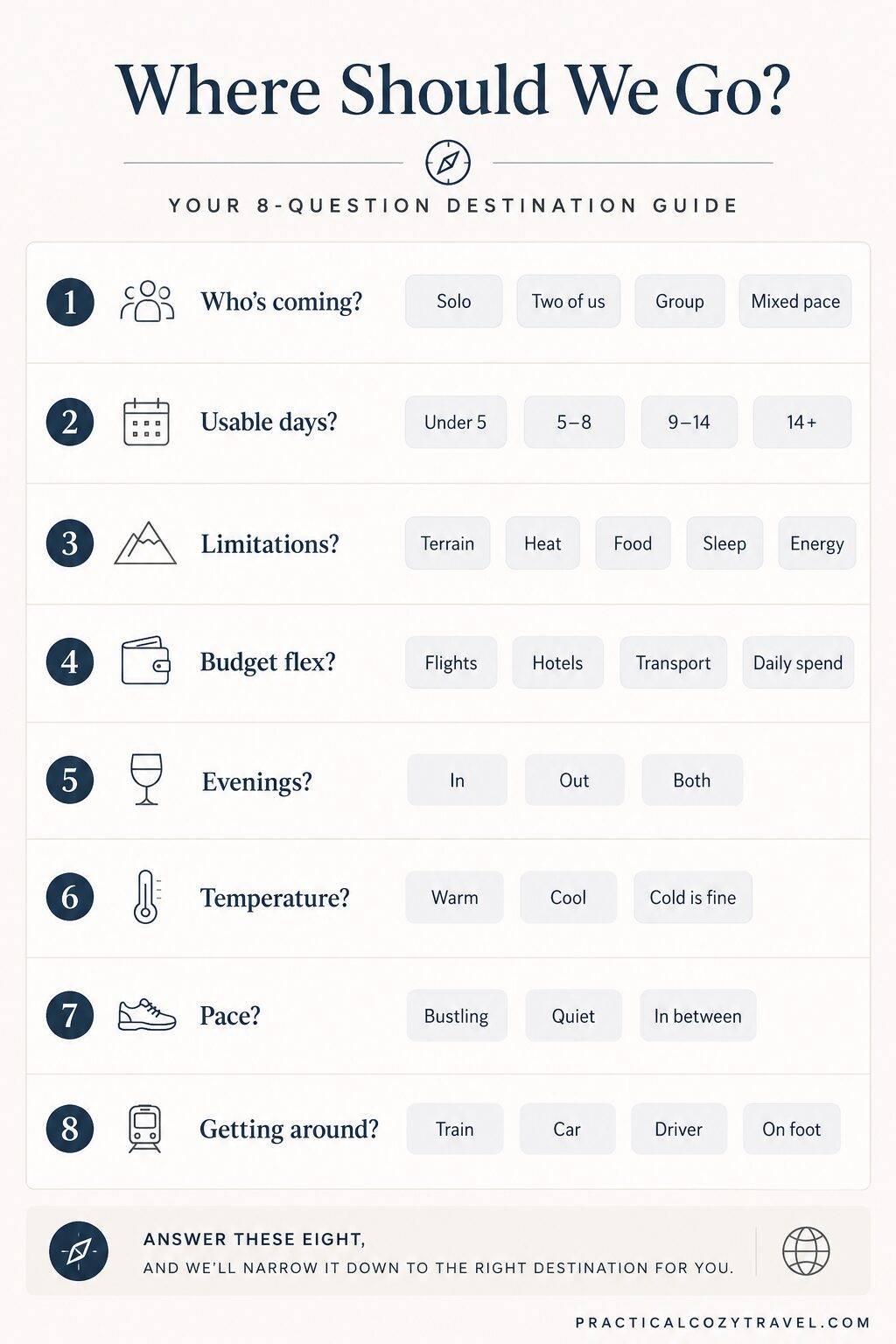
- Who’s coming, and whose pace sets the trip?
- How many usable days are left after travel and arrival day?
- What can’t my body do comfortably — hills, heat, long days, unpredictable food?
- Which budget bucket can flex: flights, hotels, transport, or daily spending?
- Am I out in the evenings or back at the hotel by eight?
- Warm or cool?
- Bustling or quiet — and can I base in one and visit the other?
- Trains, car, driver, or purely on foot?
Then pick the destination that fits those answers, not the one that fits the highlight reel. The right trip is the one that still feels good on day four — when you’re a little tired, a little footsore, and very glad you didn’t book something more ambitious.
Leave a Reply