Tag: stress-free travel

  • How to Pick Your Next Destination: 8 Questions That Do the Deciding for You

    How to Pick Your Next Destination: 8 Questions That Do the Deciding for You

    Most destination advice starts in the wrong place. It hands you a list of ten beautiful cities and lets you sort it out from there, which is how people end up booking a trip that photographs beautifully and exhausts them by day three.

    I’ve come around to a different approach. Answer eight questions about yourself — who’s coming, how long you have, what your body and your budget will actually tolerate — and the destination mostly picks itself. The map narrows on its own.

    Answer these quickly and honestly. Your gut answer is the useful one. Aspirational answers are how you end up with a rental car in a medieval old town at 9pm looking for parking.

    Two notes before we start. Each answer below points at a type of place first and names examples second — the type is the part that matters, because it’s what lets you apply this to somewhere I’ve never mentioned. And where a place is linked, I’ve been there and written about it. My travel skews European, so that’s where the first-hand recommendations cluster; everywhere else is a starting point for your own research rather than a personal endorsement.

    1. Who’s actually coming?

    This decides more than anything else on the list, and it’s the question people skip fastest.

    • Just me. You can optimize entirely for your own pace, which is a genuine luxury. Look for a walkable city with a good café culture, where sitting alone with a book at dinner is completely normal, and where you feel comfortable walking back to your hotel after dark.
    • Me and one other person. The easiest group size there is. Two people can abandon a plan at 2pm and go sit by a canal instead. You can afford a more ambitious itinerary because you can course-correct without a committee.
    • A small group of adults. Decision fatigue becomes the real enemy — not distance, not budget. Pick one base, agree in advance that splitting up for an afternoon is normal and not rude, and book dinners ahead so nobody’s standing on a corner at 7pm negotiating.
    • Mixed ages, mixed paces. The trip runs at the pace of whoever is most tired, most overheated, or most footsore. That’s not a compromise, it’s just physics. Choose a place where doing less is still worth doing — a town where the sitting-and-watching is as good as the sightseeing.
    • Solo → a dense, transit-rich city where a table for one is unremarkable. Amsterdam, Copenhagen, Edinburgh, Lisbon, Tokyo, Montreal.
    • Mixed group → a mid-size base with rail service out to smaller places, so the fast people and the slow people can split the day and reconvene at dinner. Luxembourg City, Strasbourg, Kyoto, Salzburg, Santa Fe.
    • Probably skip: Multi-stop rail loops with a big group, remote stays where one restaurant serves everyone, and anywhere the day hinges on a single strenuous activity everyone has to be up for.

    Our summer trip through Belgium, Luxembourg, Alsace, and Switzerland was five travelers, and that number is exactly why we structured it as a few multi-night bases with day trips out, rather than a new hotel every night. Five people packing and unpacking daily would have been the whole vacation.

    2. How many days do you really have?

    Not the number on your time-off request. Subtract the flight over, subtract the flight back, and subtract most of your first day on the ground, because a long-haul arrival day is for showering, walking slowly, and eating an early dinner. Whatever’s left is your actual trip.

    • Under 5 usable days. One city. No day trips, or one at most. Fly into the place you actually want to be.
    • 5 to 8 usable days. One base, two or three day trips out from it. This is the sweet spot for a first international trip, and it’s far more restful than it sounds.
    • 9 to 14 usable days. Two or three bases in one region, three nights minimum each. Now a multi-country or cross-country loop is realistic.
    • Two weeks or more. You can add a genuine rest day in the middle. Do it. A day with nothing on it is what keeps week two from feeling like a chore.
    • Short trip → one city, direct flight, no time lost to jet lag. Domestically that means Charleston, New Orleans, Savannah, Montreal, or Quebec City. Overseas, the ones with the most direct routes: Dublin, Amsterdam, Lisbon, Edinburgh, Reykjavík.
    • 9 to 14 days → one region, a few bases, short hops between them. A Belgium-to-Alsace-to-Switzerland run like ours, a Tokyo–Kanazawa–Kyoto line, Portugal end to end, or a Utah national parks loop.
    • Probably skip on a short trip: Anything requiring an internal flight, Scandinavia end to end, London-and-Paris-in-five-days, and Japan — which deserves more than a long weekend after a flight that long.

    My one hard rule: three nights per base. Two nights means one full day, because arrival afternoon and departure morning don’t count. The math is brutal and it’s why so many itineraries feel like a scramble.

    3. What are your limitations — honestly?

    This is the question I want you to answer least aspirationally of all. Limitations aren’t a smaller trip. They’re a filter, and the trip that comes out the other side is usually better than the one you’d have picked without them.

    • Terrain. Cobblestones, hills, and stairs are the three things that quietly wreck a travel day. Luxembourg City’s lower town is gorgeous and climbing back out of it is genuinely brutal — there’s a free public elevator, and knowing that in advance is the difference between a good day and a bad one. Ask whether the place you’re eyeing is flat.
    • Heat. Air conditioning is not a given in European hotels, restaurants, or trains, and humidity does its own damage elsewhere. If you run hot, midsummer in a stone city is a real risk, not a minor inconvenience. Here’s how I handle it.
    • Food and digestion. If you have IBS, celiac, allergies, or you just know your system, this belongs in the destination decision and not only in the packing list. I research bathrooms, breakfast options, and pharmacy access before I book, not after.
    • Sleep. If you sleep badly in noise, a room over a nightlife street in a busy city center will cost you the whole trip. It’s worth paying more for a quiet side street.
    • Energy. Be honest about how many hours a day you actually want to be out. Four good hours beats nine mediocre ones.
    • Terrain limits → flat, compact, and well served by trams, buses, or a metro when you’re done walking. Amsterdam, Bruges, Ghent, Colmar, Copenhagen, Kyoto, Chicago, Washington DC.
    • Heat-sensitive → go north, go coastal, or go up. Switzerland, Scotland, Norway, the Pacific Northwest, coastal Maine — or anywhere southern in April, May, or October instead of July.
    • Probably skip: Hill towns and stair cities. Lisbon’s Alfama, Edinburgh’s Old Town closes, Cinque Terre, Dubrovnik, Santorini, Tuscan hilltop villages, and San Francisco are all beautiful and all vertical. Add Japan in August, which is punishingly humid, and anywhere your main sight is a long uphill walk with no alternative transport.

    4. What’s the budget, and which part of it can flex?

    A number by itself doesn’t help you pick. What helps is knowing which of the four buckets you’re willing to stretch: getting there, sleeping, moving around once you’re there, and eating.

    • Flights are the constraint. Let the cheap route pick the region, then build the trip around wherever you can land affordably. This is the single biggest lever there is.
    • Lodging is the constraint. Fewer bases. Every hotel change costs you a night’s rate and a half-day of logistics. A hotel with breakfast included saves real money and, more importantly, saves a decision every single morning.
    • Daily spending is the constraint. This is where the choice of country matters enormously.
    • Money is not the constraint, time is. Buy the direct flight, buy the private transfer for the ugly leg, buy the hotel with the good location. Convert money into hours and energy.
    • Tight daily budget → somewhere the everyday costs are low, not just the flight. Portugal, Poland, Czechia, Hungary, much of Germany, Mexico. Japan belongs here too, which surprises people — the food and the trains cost far less than the airfare suggests.
    • Budget can flex → the places that are worth it and will charge you for it. Switzerland, Norway, Iceland, Hawaii. Go in knowing a casual lunch in Zurich costs what a nice dinner costs elsewhere.
    • Probably skip on a tight budget: Switzerland, Iceland, Scandinavia, Hawaii — not because you can’t do them, but because the constant math will follow you around all week. Same for Paris, London, Amsterdam, and New York in peak season, where lodging alone eats the plan.

    Shoulder season deserves a mention here because it moves every bucket at once — cheaper flights, cheaper rooms, thinner crowds, better weather in a lot of places. Late April to early June and September into October are where the value lives.

    5. Evenings in, or evenings out?

    Nobody asks this and it changes everything about which place fits you.

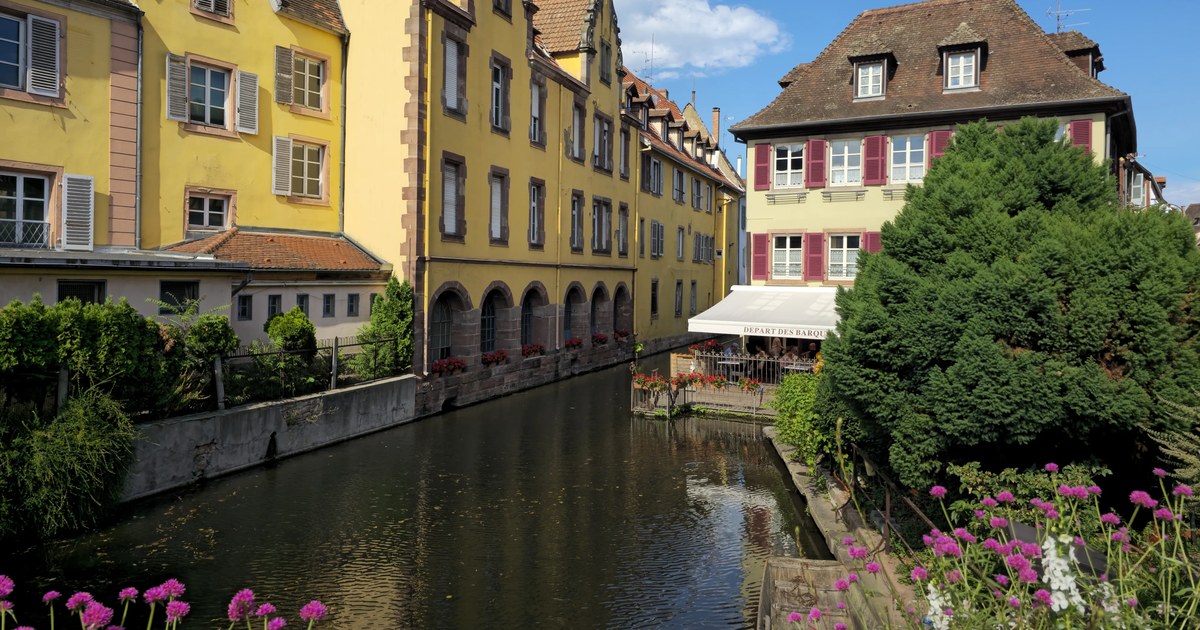
    A wide, still stretch of canal in Strasbourg with a weeping willow and stone buildings reflected in the water, almost nobody around
    A quiet stretch of water in Strasbourg on a weekday afternoon. If your evenings are in, this is the trip you’re shopping for.
    • Evenings in. Then the hotel is the trip, and you should spend accordingly. You want a room with a real chair, a decent bathroom, and ideally a kettle. Bring something to do with your hands; I keep a small puzzle book in my bag for exactly this.
    • Evenings out. Then density is what you’re shopping for. You want dinner, a drink, and a walk home all inside a ten-minute radius. A charming village where the two restaurants close at 8:30 will frustrate you.
    • Genuinely both. Base in the lively place and day-trip to the quiet ones. That direction works far better than the reverse, because getting into a lively city for the evening is much harder than getting out of one for the afternoon.
    • Evenings in → a small town, a lake, or a mountain base where the view from the room is the entertainment. Bruges once the day-trippers leave, Colmar, Lucerne, Alsatian wine villages, a ryokan in small-town Japan, the Oregon coast, coastal Maine.
    • Evenings out → a city center with restaurants and bars inside a ten-minute walk, ideally where the crowd is local rather than touristic. Madrid, Lisbon, Berlin, Porto, Ghent, Tokyo, Osaka, Mexico City, New Orleans, Montreal.
    • Probably skip: If your evenings are out, skip tiny villages, small towns where kitchens close by nine, and resort areas off-season. If your evenings are in, skip a hotel on a main square in high summer — the noise is the whole point of that location.

    6. Warm or cold?

    Answer for your actual thermostat, not for the version of you who likes the idea of a beach.

    • I’d rather be warm → south, and shoulder season if you don’t want to fight crowds. Spain, Portugal, southern Italy, Greece, Malta, Croatia, Mexico, the Caribbean, Hawaii, the American Southwest in spring. Check whether your lodging has air conditioning rather than assuming.
    • I’d rather be cool → north, coastal, or up in elevation. Switzerland and Austria in summer are the good trick — you can take a lift up and drop ten degrees in twenty minutes. The Netherlands, Belgium, Ireland, coastal Scotland, the Pacific Northwest, and coastal Maine rarely get properly hot. Japan is lovely in spring and fall and miserable in August.
    • Cold doesn’t bother me → off-season anywhere good. This is a real advantage and most people won’t use it: empty museums, cheap hotels, cozy evenings. Scotland taught me that. Vienna, Prague, the German and Alsatian Christmas market towns, Quebec City in winter, and Hokkaido are all at their best in the cold.

    Overheating is the single most underrated trip-ruiner I know. Being cold is a jacket problem. Being hot, in a city with stone streets and no shade and no air conditioning to come back to, is an all-day problem. If you run warm, the honest advice is to skip the hot places in July and August entirely — not to pack better for them.

    7. Bustling or quiet?

    Cities aren’t better or worse than small towns, they’re a different trip, and the mismatch is what makes people say a famous place was overrated.
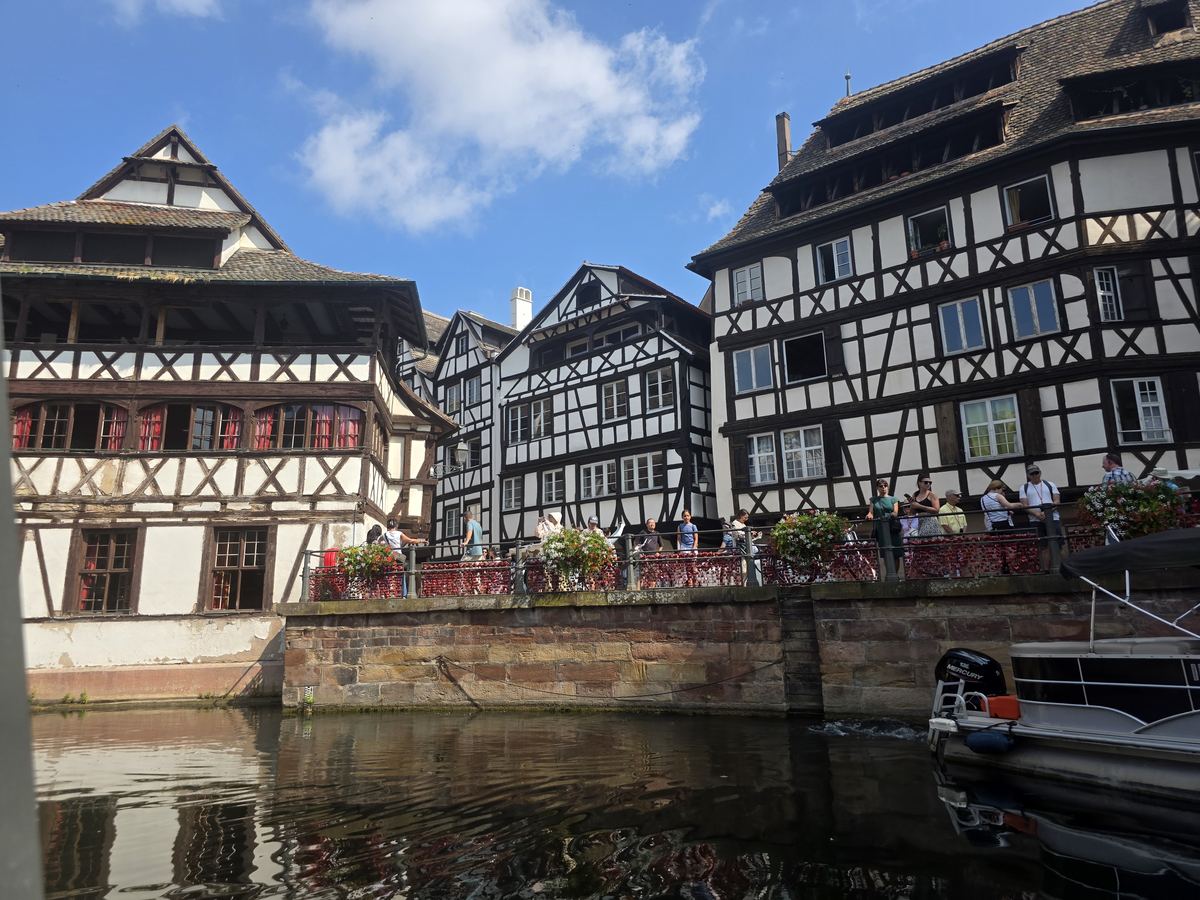
    Crowds of visitors packed shoulder to shoulder on a flower-lined bridge in front of Strasbourg's half-timbered Petite France houses on a summer afternoon
    Petite France, the same city as the photo above, a short walk away. Same afternoon, completely different trip.
    • Bustling → a big city with distinct neighborhoods, museums, and late dinners. Paris, Berlin, Madrid, London, Amsterdam, Rome, Tokyo, New York, Mexico City.
    • Quiet → a small town, a coastline, or a valley where you walk the same three streets twice and start recognizing the shopkeepers. Durbuy, Colmar, Riquewihr, the villages around Lake Lucerne, the Scottish islands, rural Ireland, the Oregon coast, Vermont.
    • In between → a mid-size city, with enough restaurants and evening life to feel alive and small enough to cross on foot. Ghent, Strasbourg, Porto, Bologna, Utrecht, Bergen, Kyoto, Portland, Savannah.

    I’ll be honest about how this played out for us. Brussels was the weakest of our three Belgian cities — it’s a working capital and it feels like one. Bruges won my heart and is very much the quiet-evening answer. Ghent landed right in the middle, with a livelier and less touristed feel. Three cities, an hour apart, three completely different trips depending on which of those you are.

    The one to skip either way: a famous small town in peak season. Bruges at noon in July is not a quiet trip and not a bustling one — it’s a queue. Go in the evening or go in the spring.

    8. How do you want to get around?

    This one looks logistical, but it’s really another energy question. The way you move between places determines how much of you is left when you arrive.

    • Trains → anywhere with a real intercity network. The most restful option there is, and the reason Belgium, Switzerland, Germany, Austria, and the Netherlands are so friendly to carry-on travelers. Japan is the best of all of them — the Shinkansen makes a multi-city trip feel like a commute. Luxembourg goes one better and makes public transit free across the whole country. In the US this really only works in the Northeast Corridor.
    • Rental car → countryside, coastline, wine regions, and national parks. The Oregon coast, Utah’s parks, Vermont, the Scottish Highlands, Iceland’s ring road, Provence, Tuscany, western Ireland. The wrong call for historic old towns, which are hostile to cars by design and expensive to park in. Also worth asking who’s willing to drive, because that person doesn’t get a vacation day.
    • A private driver for one hard leg. My favorite splurge and the most under-considered option on this list. We used one for the long country-to-country stretches, which let us break the drive with stops we’d never have reached by train. You don’t have to do it for the whole trip. One leg is often enough.
    • Walking only → one dense, flat base and a two-mile radius. Entirely valid, and some of the best trips I’ve taken have looked like this. Bruges, Ghent, Colmar, Lucerne’s old town, central Copenhagen, Kyoto’s Gion, old Quebec City.

    What to skip: don’t rent a car for a trip that’s mostly city stops, and don’t try to do a rural region — the Highlands, the Dolomites, rural Ireland, the American West — on public transit alone. Both are the classic mismatch, and both turn a good trip into a logistics project.

    Putting your answers together

    Two answers usually do most of the work, and the pace question and the transport question are the two. Find the combination that sounds like you:

    • Bustling + public transport → a big city with a real metro, and no car at all. Tokyo, Berlin, Madrid, Amsterdam, New York, Mexico City. Stay central, go deep on one place instead of wide across three.
    • Quiet + car → a rural drive with one or two bases and scenery between them. The Oregon coast, the Scottish Highlands, Vermont in fall, Iceland’s ring road, western Ireland. Accept that the driving is part of the trip rather than a tax on it.
    • Quiet + trains → small towns strung along a rail line. Alsace, the Belgian canal cities, the villages around Lake Lucerne, small-town Japan. All the calm of the rural version without anyone having to drive.
    • In between + trains → a mid-size city as a base, day trips out. Ghent, Strasbourg, Kyoto, Porto, Bologna. This is the most forgiving setup there is for a mixed-pace group.
    • Bustling + car → usually a mismatch. If the destination is a big city, park the car or skip it. If you’ve rented one for the countryside portion, drop it before you hit the city and pick it up after.

    Then layer in the other answers to narrow further:

    • Short trip, no jet lag, want it easy. A domestic or near-abroad city break — Charleston, New Orleans, Montreal, Quebec City. One base, four days, no internal travel.
    • Mixed ages and paces, heat-averse, want to do less. One base with a genuinely nice hotel, day trips out, a rest day in the middle. Switzerland or the Alps if the budget stretches, Germany or Luxembourg if it doesn’t.
    • First big international trip, and you want everything to work. Japan. The trains run to the second, the hotels are immaculate, and there’s excellent food at every price point.
    • Solo, longer trip, tight daily budget, happy alone in the evening. Portugal, Poland, or Czechia in shoulder season. Long stays, a rail pass, slow days.
    • Real mobility or terrain limits. Flat, dense, transit-rich: the Netherlands, northern Belgium, Copenhagen, Kyoto, Chicago, Washington DC — modern or flat centers rather than hilltop old towns.

    The one-page version

    Screenshot this and answer it in a notes app before you open a single booking site:
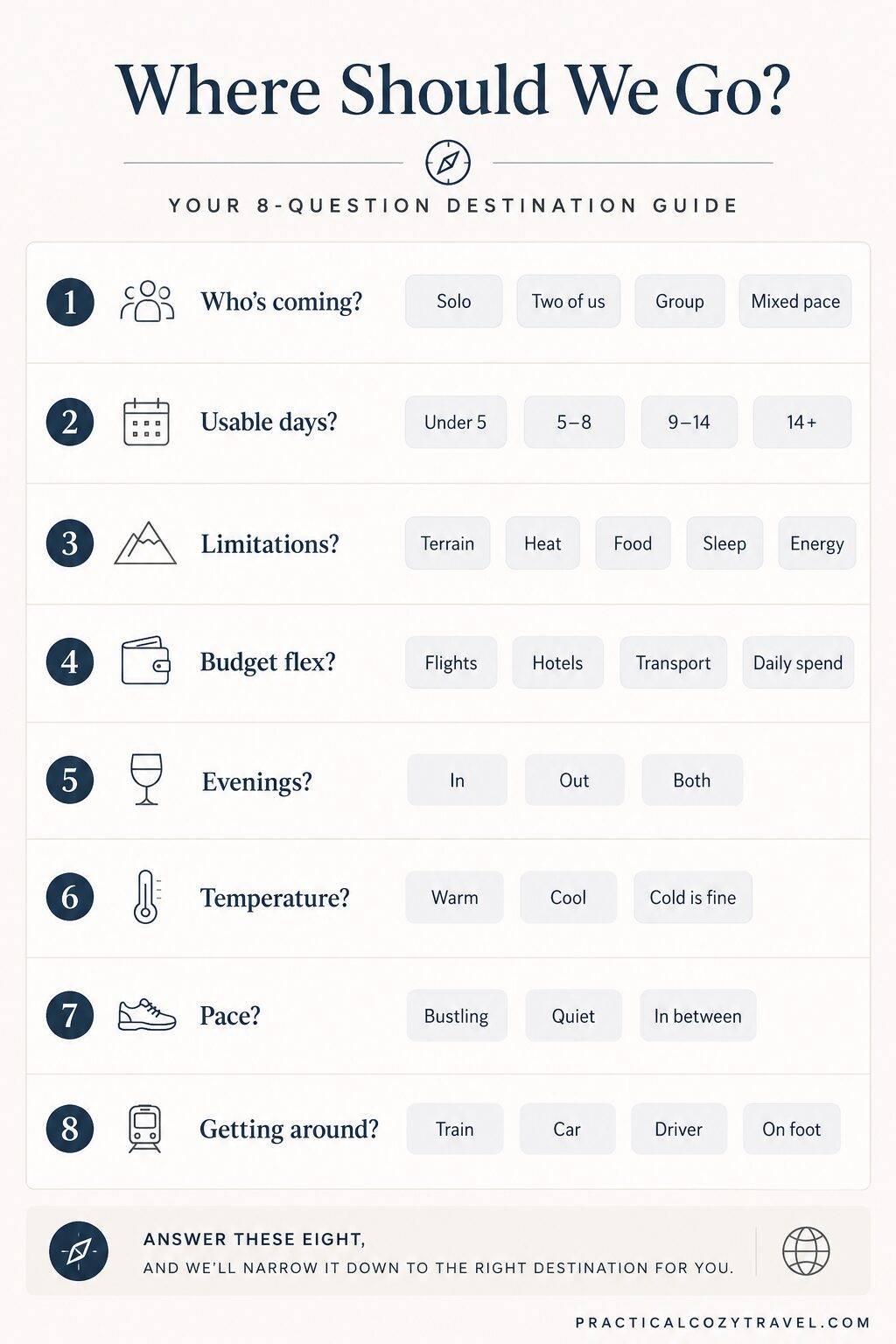
    Chart titled Where Should We Go, listing the eight destination questions and their answer options: who's coming, usable days, limitations, budget flex, evenings, temperature, pace, and getting around
    Save this one to your phone.
    1. Who’s coming, and whose pace sets the trip?
    2. How many usable days are left after travel and arrival day?
    3. What can’t my body do comfortably — hills, heat, long days, unpredictable food?
    4. Which budget bucket can flex: flights, hotels, transport, or daily spending?
    5. Am I out in the evenings or back at the hotel by eight?
    6. Warm or cool?
    7. Bustling or quiet — and can I base in one and visit the other?
    8. Trains, car, driver, or purely on foot?

    Then pick the destination that fits those answers, not the one that fits the highlight reel. The right trip is the one that still feels good on day four — when you’re a little tired, a little footsore, and very glad you didn’t book something more ambitious.
    Related reading

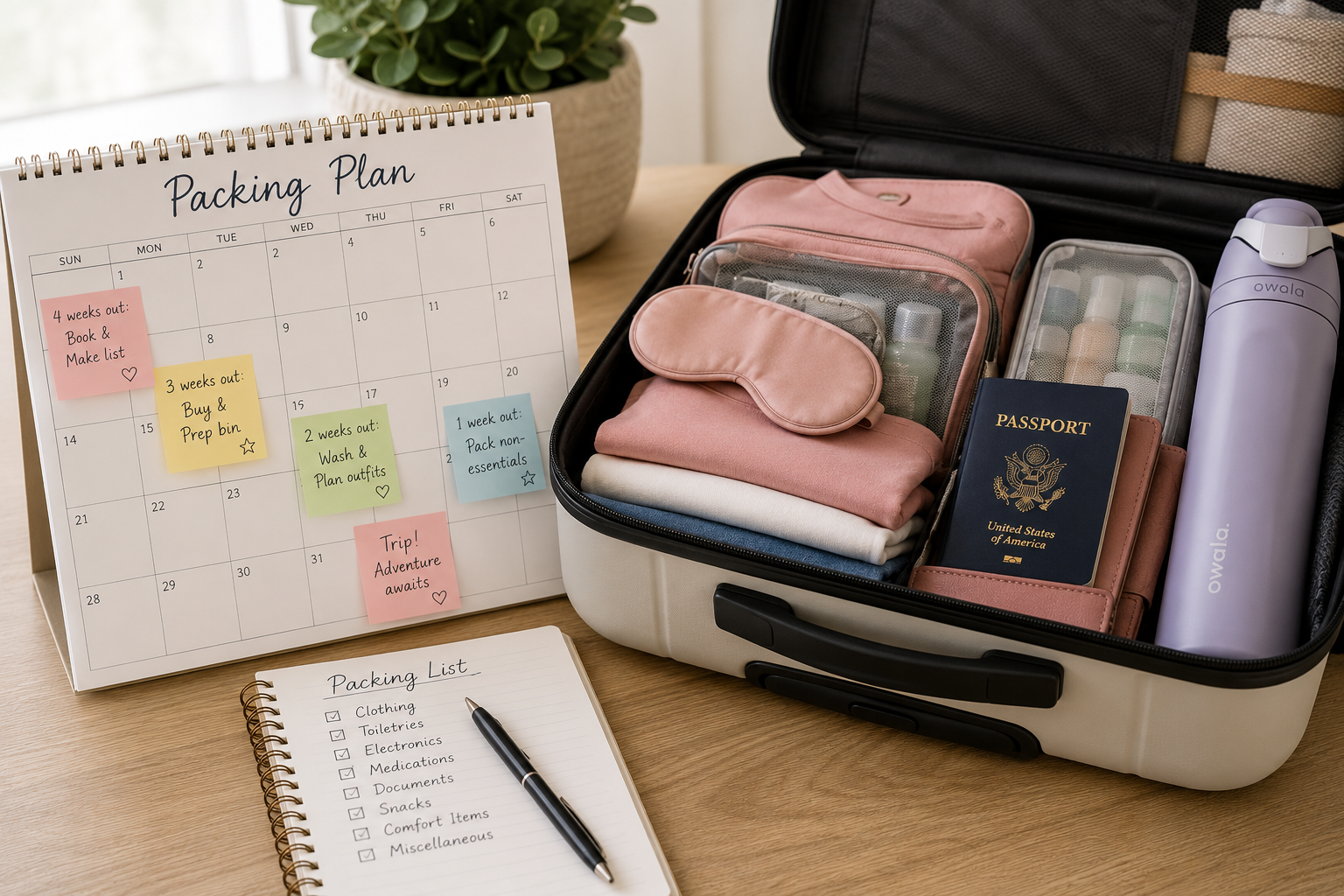
  • How I Start Packing Weeks Before a Trip (Without Living Out of a Suitcase)

    This post contains affiliate links. If you buy through them, I may earn a small commission at no extra cost to you — it helps keep this little blog running. I only recommend things I actually use.

    I used to be the person still packing at midnight the night before a flight — half my closet on the bed, a cat sitting in the empty suitcase, and me completely convinced I’d forgotten something important. (I usually had.)

    These days I start packing weeks ahead. But before you picture a suitcase sitting open in the middle of my bedroom collecting cat hair for a month — that’s not what this is. I have a slow, low-effort system that lets me pack a little at a time, spread the cost out, and show up at the airport calm instead of frazzled. Here’s exactly how the weeks before a trip actually look for me.

    Packing gradually in the weeks before a trip

    Four Weeks Before: The Big Stuff Should Already Be Locked In

    Honestly, most of my booking happens way earlier than four weeks out — flights especially, since that’s where the good prices live, and I’ve usually grabbed those two or three months ahead. But if I’m being realistic about a minimum, everything major is booked no later than about three weeks before I leave:

    • Flights
    • Hotels
    • Tours and activities
    • Rental car
    • Travel insurance

    By the four-week mark I want all of that done, so the countdown is about preparing — not scrambling to make decisions.

    Make a Packing List (by Category, Not Chaos)

    I don’t write one long random list — that’s exactly how things slip through. I break it into categories so my brain has somewhere to put each item:

    • Clothing
    • Toiletries
    • Electronics
    • Medications
    • Plane essentials
    • Camera gear
    • Documents

    Once the categories exist, I just fill them in over the next few weeks as things occur to me.

    Three Weeks Before: Start Buying What’s Missing

    This is when I start ordering the little things I know I’m out of or low on:

    • Sunscreen
    • Travel-sized bottles
    • Electrolytes (a non-negotiable for me — more on why in a second)
    • Protein bars and safe snacks
    • New walking shoes, if the old pair is done
    • Compression socks for the flight

    A quick honest aside: I have IBS, and I don’t drink coffee, so I’ve learned the hard way not to count on whatever’s being served in the air. There was a flight to Scotland where the plane food and I did not get along, and I spent the descent regretting every decision that led me there. Now I always travel with snacks I know my stomach is fine with, plus electrolytes, so a long travel day doesn’t wreck me.

    Spreading these purchases over a few weeks also just feels better. Buying everything the week before means one brutal few-hundred-dollar order all at once. Doing it gradually barely registers.

    Create a Travel Bin

    This is probably my favorite habit on the whole list. I grab one basket or tote and it becomes the landing spot for everything trip-related. As items arrive or turn up around the house, they go straight in:

    Nothing gets scattered across three rooms. When it’s finally time to pack, it’s all in one place. A small electronics organizer lives in there too, which keeps the cable spaghetti under control.

    Two Weeks Before: Laundry and Prescriptions

    Wash Everything You Want to Bring

    Nothing derails a packing list like realizing your favorite travel shirt is sitting damp at the bottom of the hamper. Two weeks out, I run whatever I’m planning to take through the wash so it’s clean, dry, and ready to go.

    Refill Medications

    This one matters more the longer you’ll be gone. I check every prescription and refill anything I’d run out of mid-trip — because sorting that out from another time zone is a headache I’ve earned once and don’t need again. A simple travel pill organizer keeps everything sorted by day.

    One Week Before: Start Packing the Non-Essentials

    Now the actual packing starts — but only the things I won’t touch before I leave:

    • Swimsuits
    • Jackets and a rain jacket
    • Chargers I don’t use daily
    • Packing cubes, loaded and ready

    Packing cubes are the thing I’d hand to past-me first. They turn a chaotic suitcase into tidy little compartments, and I can pull out a whole “category” without excavating everything else. I keep a travel laundry bag tucked in one of them for dirty clothes on the way home. And if you wind up somewhere without one — a hotel stay, say — one of the hotel laundry service bags or even a spare trash bag does the job just fine.

    Double-Check Every Reservation

    A week out, I go back through and confirm:

    • Flights
    • Hotels
    • Tours
    • Airport transfers and transportation

    Better to catch a wrong date now than at a check-in desk.

    Three Days Before: The Big Pack

    This is when the suitcase really fills up:

    • Most of my clothing
    • Toiletries I won’t need in the next few days (my hanging toiletry bag makes this painless)
    • Electronics I’m not using daily

    I also weigh the bag with a luggage scale at this point, so an overweight fee is never a surprise at the counter.

    The Night Before: Almost Nothing Left

    If I’ve done the earlier steps, the night before is calm. Only the daily-use stuff is still out:

    • Toothbrush
    • Phone charger
    • Whatever I’ll actually use in the morning

    I toss those in, and I’m done. No midnight closet raid. (Jasper and Nugget are always very invested in supervising this part — Nugget in particular considers the open suitcase her personal property.)

    My Travel-Morning Checklist

    Right before I walk out the door, I run one final check. These are the things that actually ruin a trip if they go missing:

    That airplane pouch is its own small ritual — snacks, electrolytes, headphones, a charger, and yes, an extra pair of undies. That last one sounds silly until a delay, a spill, or a rough travel day makes you deeply grateful they’re in your day bag and not in a checked suitcase somewhere over the Atlantic.

    Since I don’t drink coffee, water is basically my entire hydration strategy on a travel day — so my Owala FreeSip water bottle comes with me everywhere. I fill it right after security and sip the whole flight; the flip-top straw lid means I’m not wrestling a cap open over a tray table.

    I also keep an AirTag or Tile tracker in my checked bag, so if it decides to wander off, I at least know where it went.

    Why I Pack Early

    Packing early buys me:

    • Less stress
    • Fewer forgotten items
    • Time to actually replace anything missing
    • Better budgeting, spread over weeks instead of one panic-spend
    • More excitement leading up to the trip

    That last one is the real payoff. Instead of dreading the night before, I get to feel the good kind of pre-trip buzz — the anticipation, not the scramble. The suitcase never lives open in my room for a month, but the trip lives happily in the back of my mind the whole time.

  • Something Small to Pack: A Travel-Size Puzzle Book

    Something Small to Pack: A Travel-Size Puzzle Book

    There’s a particular kind of empty time that comes with travel. The hour before boarding. The long train stretch where the scenery goes quiet. The waiting room, the layover, the evening in an unfamiliar hotel when you’re not quite ready to sleep. I used to fill it with my phone. Lately I’d rather not.

    So I made something to slip in my bag instead.

    The Cozy Travel Pocket Puzzle Book is exactly what it sounds like — a take-along collection of travel-themed puzzles, sized to tuck beside your passport and pull out whenever the waiting starts. It’s the little sister to my full-size activity book: same comfort-first spirit, but compact, and built for the road rather than the rainy afternoon at home.

    What’s inside

    It’s a proper mix, so there’s always something that fits the moment and the amount of time you’ve got:

    • 14 word searches — from European postcards to desert journeys
    • 10 crosswords with kind, never-cruel clues
    • Cryptograms, travel trivia and anagrams for the short, satisfying stretches
    • “Find Your Way to…” mazes that wind toward a little landmark at the finish
    • Writing prompts for when the view out the window gets you reminiscing
    • And a complete answer key in the back

    Every puzzle is brand new — none of them are repeats from the larger book — so if you happen to have both, you’re not solving the same grid twice. I made the clues gentle on purpose. This is the kind of thing you do with a paper cup of tea balanced on a tray table, not the kind that makes you want to throw the pencil.

    Who it’s for

    If you’re the sort who’d rather wind down with a pencil than a screen — on a plane, a long drive, or a quiet evening away — this was made for you. The compact 6 x 9 size means it actually fits in the bag you’re already carrying.

    It also makes a lovely little gift: a stocking stuffer for a traveler, a get-well book for someone stuck waiting, or a thank-you for the friend who’s about to face a very long flight.

    Where to find it

    The Cozy Travel Pocket Puzzle Book is available now in paperback on Amazon. → Get your copy here

    Tuck it in your bag, find a comfortable seat, and let the waiting become the nice part.

    — Meghan

    As an Amazon Associate I earn from qualifying purchases.

  • For the Days Between Trips: A Cozy Travel Activity Book

    For the Days Between Trips: A Cozy Travel Activity Book

    Not every day can be a travel day. Some days it’s raining, the suitcase is in the closet, and the next trip is just a vague little daydream on the calendar. Those are the days I like best for a cup of tea, a comfortable chair, and something to do with my hands that isn’t a screen.

    So I made a book for exactly those afternoons.

    The Cozy Travel Activity Book is a screen-free escape for grown-ups who love to wander — a generous mix of travel-themed puzzles and gentle reflection, all in the same comfort-first spirit as everything else around here. It’s the thing I reach for on a long flight, a slow Sunday, or an evening when I’d rather wind down with a pencil than scroll.

    What’s inside

    It’s a proper mixed bag, so there’s always something for the mood you’re in:

    • 12 word searches — from European capitals to camping trips
    • 10 crosswords with easygoing, never-frustrating clues
    • 10 cryptograms to crack (each one hides a little travel saying, with a starter hint)
    • 32 travel trivia questions to test how worldly you really are
    • Anagrams and six “Find Your Way to…” mazes that wind toward a little landmark at the finish, from the Eiffel Tower to a cozy cabin
    • 6 fill-in-the-blank rounds, each with a word bank to help
    • 12 writing prompts for reminiscing about trips past and dreaming up the next one
    • And a complete answer key in the back — no judgment if you peek

    I kept the clues kind and the pace unhurried on purpose. This isn’t the kind of puzzle book that makes you feel like you’re sitting an exam. It’s the kind you do with a cup of something warm, half-watching the rain, with a cat trying to sit on the page.

    Who it’s for

    If you’re a traveler in between trips, a retiree with time to fill pleasantly, or someone who’d simply rather unwind with a pencil than a phone, this was made for you. The 8.5 x 11 pages are nice and roomy, with plenty of space to write.

    It also makes a genuinely thoughtful gift — for the friend who’s always planning their next escape, a relative heading into retirement, or anyone facing a long-haul flight who’ll thank you somewhere over the ocean.

    Where to find it

    The Cozy Travel Activity Book is available now in paperback on Amazon. → Get your copy here

    Grab a pencil, find a comfortable seat, and wander at your own pace.

    — Meghan

    As an Amazon Associate I earn from qualifying purchases.

  • I Made a Travel Journal for People Who Travel Like I Do

    I Made a Travel Journal for People Who Travel Like I Do

    There’s a moment on every trip I take that I never plan for. It’s not the famous square or the must-see view. It’s the window seat in a quiet café where I sat longer than I meant to, watching a town go about its afternoon. That’s the moment I actually remember months later — and it’s the one no itinerary ever tells you to write down.

    So I made a journal that does.

    Cozy Travels is a comfort-first travel journal, and it comes from the same place this whole blog does: the belief that a trip should feel restful, not rushed. Every travel journal I picked up over the years assumed I wanted to schedule my days down to the minute and tick off a list of sights. That has never been how I travel. I travel slowly. I take the rest day. I go back to the same bakery three times. I wanted a journal that made room for that kind of trip.

    What’s inside

    It’s built in three gentle parts, so you can use as much or as little as fits the trip you’re on:

    • Reusable planning pages — packing lists with a dedicated spot for your comfort items (the real essentials), plus a weather-and-outfit planner, a place-to-stay log with comfort ratings, and simple transit and budget trackers.
    • 50 daily spreads — room for the day’s highlights, what you ate, a quick mood-and-energy check, and my favorite part: a Comfort Find of the Day prompt to capture the café, the bench, or the view that made the day feel easy.
    • Keepsake pages — a Cozy Spots log, a places-to-eat list, a souvenir page, and end-of-trip reflections you’ll actually want to reread on a grey afternoon at home.

    The thing I’m proudest of is small: there’s a pace tracker on every single day. Slow, medium, or full. Because a morning spent doing nothing by a window counts just as much as a packed afternoon of sightseeing — and most journals quietly make you feel like it doesn’t.

    (There’s a “what I ate” section too, and yes, the café it keeps nudging you toward can absolutely be a tea house. I’ve never liked coffee and I refuse to be made to feel bad about it.)

    Who it’s for

    If you’re a slow traveler, a solo wanderer, or someone who finds a blank journal a little intimidating, this was made with you in mind. The prompts do the work, so there’s no pressure to fill a perfect page. It also makes a genuinely lovely gift — for the friend who needs a slower kind of vacation, or someone heading into retirement with a list of places they’ve been saving up for.

    I write everything here from my own trips, usually with two very unimpressed cats waiting for me to come home. This journal is the one I wish I’d had on every one of them.

    Where to find it

    Cozy Travels is available now in paperback on Amazon. → Get your copy here

    Wishing you slow mornings, good views, and a comfortable seat wherever you wander.

    — Meghan

    As an Amazon Associate I earn from qualifying purchases.

  • How I Prepare My Cats Before a Trip (So I Can Actually Enjoy Being Away)

    How I Prepare My Cats Before a Trip (So I Can Actually Enjoy Being Away)

    This post contains affiliate links. If you purchase through a link, I may earn a small commission at no extra cost to you. Full disclosure here.

    Packing for a trip when you live alone with two cats means you’re actually preparing for three departures: yourself, your home, and your pets. The logistics of my own travel — packing, getting to the airport — are the easy part. Making sure Jasper and Nugget are taken care of while I’m gone is what I think about more.

    I’m lucky. I have family who can usually step in to watch them, depending on who’s traveling with me. But even with people I trust completely, I don’t just hand over a key and hope for the best. Jasper is pretty easy. Nugget is shy enough that first-time cat sitters can go an entire visit without actually seeing her. There’s prep involved, and over the years I’ve figured out what actually makes a difference.

    Here’s how I set up the house before I leave.

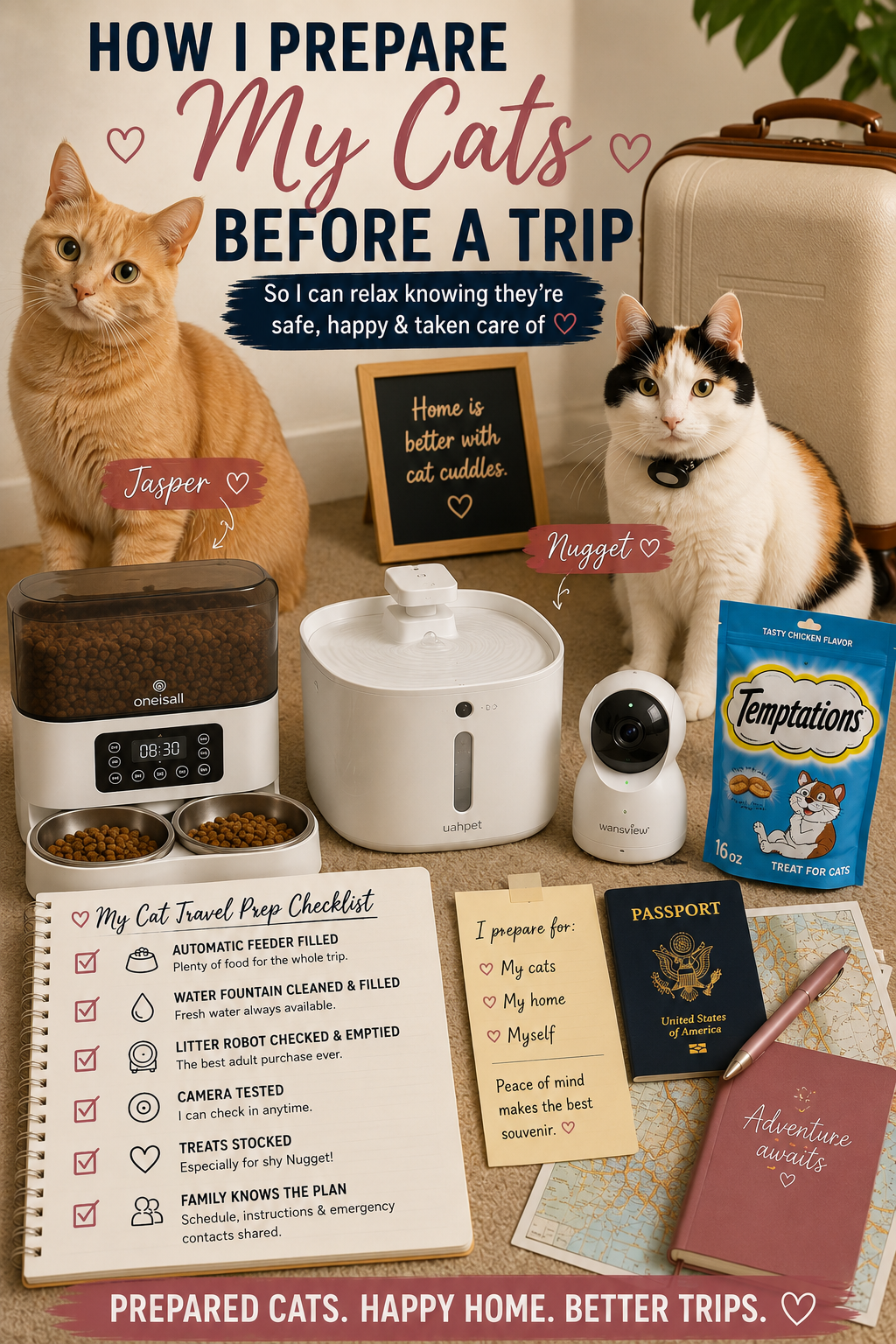
    How I prepare my cats Jasper and Nugget before a trip — cat travel prep checklist infographic

    The Feeder: One Less Thing to Coordinate

    Even when someone is coming to check on the cats, I run an automatic feeder. It removes the timing pressure from whoever is watching them — they don’t have to be there at exactly 7am and 6pm, the feeder handles it.

    The oneisall Automatic Cat Feeder holds up to 20 cups and works for two cats, which is exactly what I needed. You can program multiple feeding times throughout the day, control portions, and it works with dry food. Having it means that even if my family member’s visit is a bit earlier or later than planned, the cats aren’t waiting on their meals. It also gives me peace of mind on longer trips or days when the schedule gets complicated.


    The Water Fountain: Worth Every Penny

    Cats are notoriously bad at drinking enough water. A stagnant bowl is usually less appealing to them than moving water, which is part of why fountains work better — but most fountains are also a cleaning hassle with pumps and filters that need regular attention.

    I switched to the uahpet Wireless Cat Water Fountain specifically because it has no pump. It’s battery-operated, has a motion sensor that activates the flow when a cat approaches, and is genuinely easy to clean. The 2L capacity is enough for a few days without needing to be refilled, and for travel it means the person checking on the cats doesn’t have to stress about water levels constantly.

    No pump was the specific feature I was looking for and I haven’t looked back since.


    The Litter Robot: My Best Adult Purchase

    I’ll say it plainly: the Litter Robot is the best thing I’ve bought for myself as a cat owner, and it makes a real difference when I travel. Not having to ask my family to scoop litter is a significant reduction in what I’m asking of them. It handles itself, has an app where I can monitor usage, and takes one major task entirely off the pet-sitting plate.

    If you’ve been on the fence, use this referral link to get $50 off. If you have cats and you travel even occasionally, I genuinely think it’s worth it.


    The Camera: For Peace of Mind (and Honestly, Because I Miss Them)

    I’ll be honest: I set up the camera partly as a practical tool and partly because I miss my cats when I travel and I like being able to check in on them.

    The wansview 2K Indoor Camera is what I use. It has motion detection, night vision, two-way audio, and connects to an app so I can see what’s happening in the house from anywhere. My family knows the camera is there — I always make sure of that. If you’re using a camera and it’s not family watching, make sure your pet sitter knows it’s there. That’s just the right thing to do.

    The motion detection is useful for catching when Nugget finally comes out to investigate a new person, and for generally knowing the cats are okay without having to text someone every few hours.


    The Treats: The Key to Nugget

    Nugget is shy. Very shy. She’s the kind of cat who will disappear for an entire visit from someone she doesn’t know well, and even with family she takes time to warm up.

    Before I leave, I always make sure we’re stocked up on Temptations Cat Treats — the Tasty Chicken flavor is the one she can’t resist — and I specifically tell whoever is watching them to use the treats as a way to coax her out. It works better than anything else. She’ll come for treats when she won’t come for anything else, and it gives the person caring for her an actual tool to check that she’s okay rather than just hoping she emerges on her own.

    Jasper needs no coaxing. Jasper will have introduced himself before the person has put their bag down.


    The Sitter Briefing: What I Actually Tell People

    Even with family who knows the cats, I always leave a note. It doesn’t have to be long, but it covers:

    • Feeding schedule and where the food is (even with the auto feeder, knowing where the backup supply is matters)
    • Any quirks — Nugget hides, use treats, she’s fine she’s just shy
    • Vet contact information
    • Where the cat carrier is, just in case
    • My number saved in their phone with permission to use it

    I also make sure they have my number and know I actually want them to text me if something seems off. I’d rather get an unnecessary check-in than have something go wrong because someone didn’t want to bother me on vacation.


    The Honest Part: Traveling Alone With Pets Takes More Preparation

    When you live alone with pets, there’s no one else to coordinate this on your behalf. You’re the one who sets up the feeder, tests the camera, stocks the treats, writes the note, and briefs whoever is coming to help. You’re also the one who fields the texts while you’re away and does a quick check of the camera app before bed even when you’re in a different time zone.

    It’s worth it. Jasper and Nugget are worth it. But I’m not going to pretend it’s effortless — it’s just part of what traveling solo with pets looks like, and getting the right setup in place makes it manageable enough that I can actually be present wherever I am instead of worrying about what I left behind.


    The Pre-Trip Pet Checklist

    Before I leave for any trip longer than a night:

    ✓ Auto feeder programmed and stocked
    ✓ Water fountain charged and filled
    ✓ Litter Robot emptied and checked ($50 off here)
    ✓ Camera online and motion alerts on
    ✓ Treats stocked (extra for Nugget)
    ✓ Sitter briefed with written notes
    ✓ Vet info and carrier location confirmed
    ✓ My number saved in their phone with permission to use it

    Get this right and you can actually enjoy being away. That’s the goal.


    As an Amazon Associate, I earn from qualifying purchases. See my full Affiliate Disclosure for details.

  • How I Prevent Stomach Issues on Long Flights

    How I Prevent Stomach Issues on Long Flights

    This post contains affiliate links. If you purchase through a link, I may earn a small commission at no extra cost to you. Full disclosure here.

    Nothing ruins the start of a trip faster than arriving bloated, nauseous, or dealing with digestive issues before you’ve even left the airport.

    I have IBS, which means I’ve had to get more deliberate about this than most people do. But even without a specific condition, long flights are genuinely hard on your digestive system — low humidity, pressure changes, sitting still for hours, disrupted meal timing, stress. Your body notices all of it.

    After years of flying for both work and vacation, these are the habits that have actually made a difference for me.

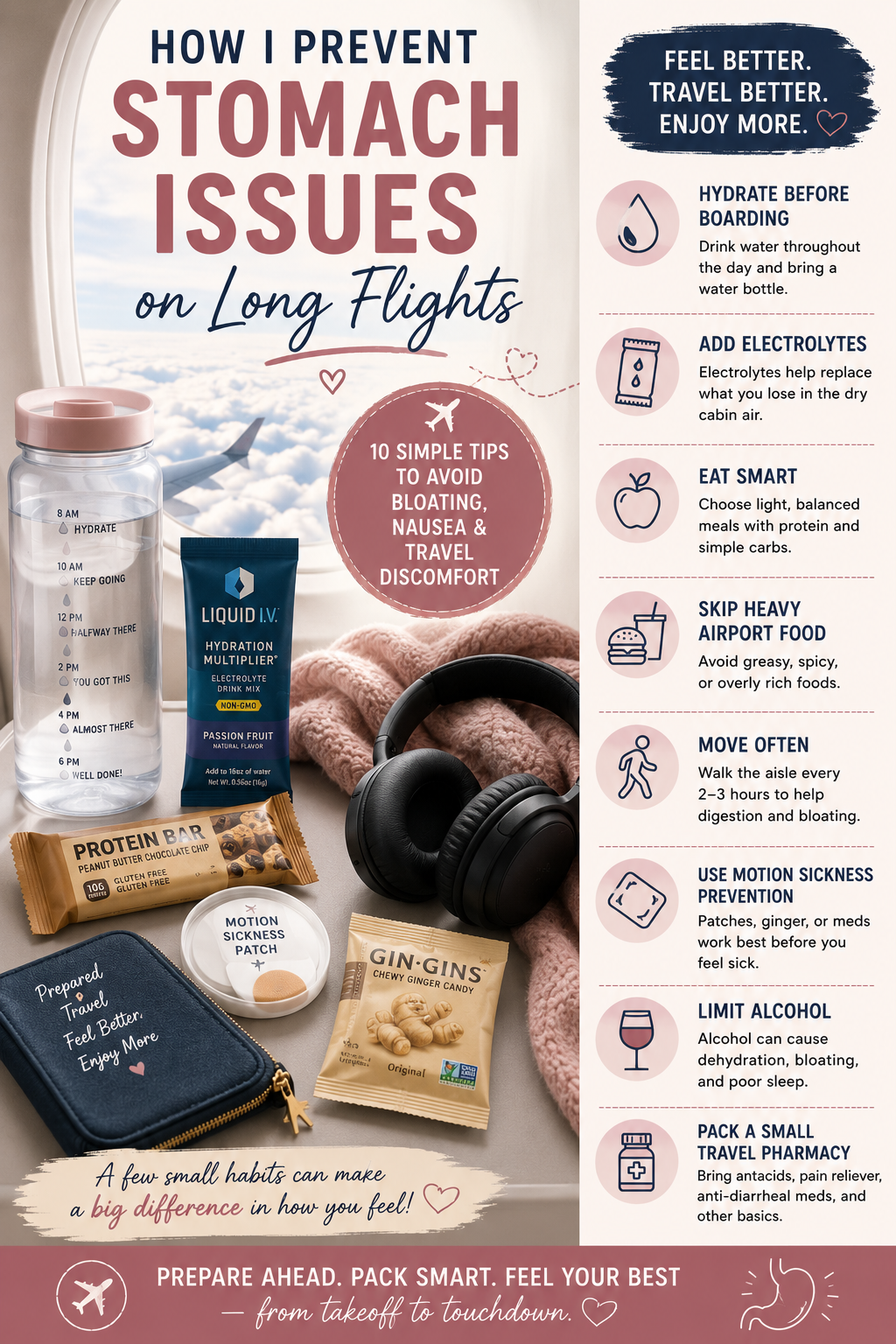
    How I prevent stomach issues on long flights — 10 simple tips infographic

    Start Hydrating Before Your Flight

    Most travelers wait until they’re thirsty. By then you’re already behind.

    Airplane cabins run at humidity levels so low they pull moisture out of everything — including you. The dehydration starts before you even reach cruising altitude, and it compounds over a long flight in ways that show up as headaches, fatigue, bloating, and general misery on arrival.

    What I do: drink water steadily throughout the day before flying, bring an empty water bottle through security, and add a Liquid I.V. Hydration Multiplier packet once I’ve filled it past the checkpoint. One packet does noticeably more than plain water — it’s the difference between drinking a lot and actually absorbing it. The Concord Grape flavor is the one I keep coming back to.


    Skip the Airport “Treat Yourself” Meal

    Airport food is designed for impulse and convenience, not for how you’ll feel at 35,000 feet.

    Greasy food, heavy portions, and alcohol are all harder to process in a pressurized cabin. For me specifically — with IBS — this is non-negotiable. But even without a digestive condition, most people feel the difference between boarding heavy and boarding light.

    Before flying I skip: heavy fried foods, large burgers, excessive dairy, and anything very spicy. What I’ll actually eat before a flight: something with protein, fruit, rice, a simple sandwich, or easy carbohydrates that won’t sit heavily.

    This doesn’t mean eating sad airport salad. It just means being honest about what your body can actually handle at altitude.


    Don’t Fly on an Empty Stomach Either

    The opposite mistake is just as bad.

    Flying hungry — especially for IBS — can trigger nausea, headaches, and motion sickness faster than almost anything else. An empty stomach on a bumpy flight is not a good combination.

    I keep a few things in my carry-on specifically for this: BUILT Bar Puff Protein Bars are my go-to because they’re light enough to eat when you’re not fully hungry but substantial enough to actually help. Trail mix, crackers, and pretzels round it out. A small snack every few hours keeps things settled in a way that nothing else quite does.


    Check the Inflight Meal Before You Board

    This one took me too long to figure out.

    Most airlines publish their inflight menus online — and many let you pre-select special meals (low-fiber, low-fat, bland options) when you book. For anyone managing IBS or digestive sensitivities, this matters enormously. The difference between a standard inflight meal and a meal you’ve actually reviewed in advance is real.

    Before any flight with meal service, I look up the menu, note what’s likely safe, and often pre-order an alternative. It takes five minutes and has saved more than a few trips.


    Use Motion Sickness Prevention Before You Need It

    Most people wait until they feel sick. By then, it’s significantly harder to manage.

    The options I keep accessible: MQ Motion Sickness Patches go behind the ear and last up to 72 hours — one patch covers the flight and whatever comes after (buses, boats, winding roads). Chimes Ginger Chews are my gentler everyday option when I just need to settle things without medication. For turbulent flights, I use both.

    If you’re prone to motion sickness at all, start prevention before boarding — not after the seat belt sign goes on during a rough patch.


    Limit Alcohol

    A glass of wine can sound like the right way to start a trip.

    But alcohol at altitude accelerates dehydration, disrupts sleep quality even when it helps you fall asleep, increases bloating, and tends to produce worse headaches than it would on the ground. On overnight or international flights especially, the cost outweighs the relaxation.

    I don’t drink on flights over a few hours. That’s a personal call, but it’s one I’ve never regretted mid-flight.


    Go Easy on Carbonated Drinks

    Cabin pressure causes gas to expand. This is straightforward physics, and your digestive system doesn’t get an exemption.

    Carbonated drinks — even sparkling water — can cause noticeably more bloating and discomfort in the air than they would on the ground. For anyone already managing digestive sensitivity, still water is the clear choice. The flight attendant offering ginger ale with kindness is a nice gesture, but the bubbles are genuinely not your friend at altitude.


    Skip the Coffee If You Can

    I don’t drink coffee, which I’ve come to think is probably an accidental advantage on travel days.

    For those who do: caffeine is a diuretic, which means it actively works against the hydration you’re trying to maintain. It can also irritate the stomach lining, increase acid production, and speed up motility in ways that become uncomfortable when you’re trapped in a small seat at 35,000 feet. Combined with the dehydration already happening from cabin air, it’s a lot for your system to manage.

    If coffee is non-negotiable, the approach that seems to help: eat something substantial first, drink extra water alongside it, and keep it to one serving rather than refilling all morning before you board. Your stomach at altitude is a different environment than your stomach at home.


    Walk Every Few Hours

    Movement helps digestion more than most people expect.

    Sitting still for hours slows everything down — circulation, digestion, all of it. Even short walks to the back of the plane and back help. I try to get up every two to three hours on longer flights, and on overnight flights I’ll do a few laps of the cabin before trying to sleep.

    COOLOVER Copper Compression Socks also help here. They improve circulation in a way that reduces the heavy, stiff feeling that sets in on long-haul flights — and better circulation means everything is moving a bit more the way it should.


    Pack a Small Travel Pharmacy

    I keep a dedicated section of my airplane essentials pouch for stomach and health items, organized in a travel pill organizer so I’m not digging through loose packets mid-flight.

    Stomach essentials: antacids, anti-diarrheal medication, Chimes Ginger Chews, MQ Motion Sickness Patches.

    General: pain reliever, allergy medication, TheraTears Eye Drops.

    Hopefully I won’t need most of it. But having it there means not spending the first hour at my destination looking for a pharmacy.


    Prioritize Sleep

    Poor sleep affects digestion more than most people connect.

    I’m noticeably more prone to stomach issues and motion sensitivity when I’m running on bad sleep. Before a long-haul flight I try to sleep well the night before, and on the plane I use Bose QuietComfort Headphones and an Albatross Eye Mask to actually rest. The noise cancellation makes a bigger difference than I expected — engine drone is more disruptive to sleep than you realize until it’s gone.

    The better rested I board, the better I feel on arrival. It’s that straightforward.


    My Long Flight Survival Kit

    For flights over four hours, this is what’s always with me:

    ✓ Liquid I.V. packet
    ✓ BUILT Bar Protein Bar
    ✓ Motion Sickness Patches
    ✓ Ginger Chews
    ✓ TheraTears Eye Drops
    ✓ Portable Charger
    ✓ Noise-Canceling Headphones

    The goal isn’t a perfect flight. It’s arriving at your destination feeling like a person — not spending the first day of your trip recovering from the journey.


    As an Amazon Associate, I earn from qualifying purchases. See my full Affiliate Disclosure for details.