Category: Packing

  • How I Start Packing Weeks Before a Trip (Without Living Out of a Suitcase)

    This post contains affiliate links. If you buy through them, I may earn a small commission at no extra cost to you — it helps keep this little blog running. I only recommend things I actually use.

    I used to be the person still packing at midnight the night before a flight — half my closet on the bed, a cat sitting in the empty suitcase, and me completely convinced I’d forgotten something important. (I usually had.)

    These days I start packing weeks ahead. But before you picture a suitcase sitting open in the middle of my bedroom collecting cat hair for a month — that’s not what this is. I have a slow, low-effort system that lets me pack a little at a time, spread the cost out, and show up at the airport calm instead of frazzled. Here’s exactly how the weeks before a trip actually look for me.
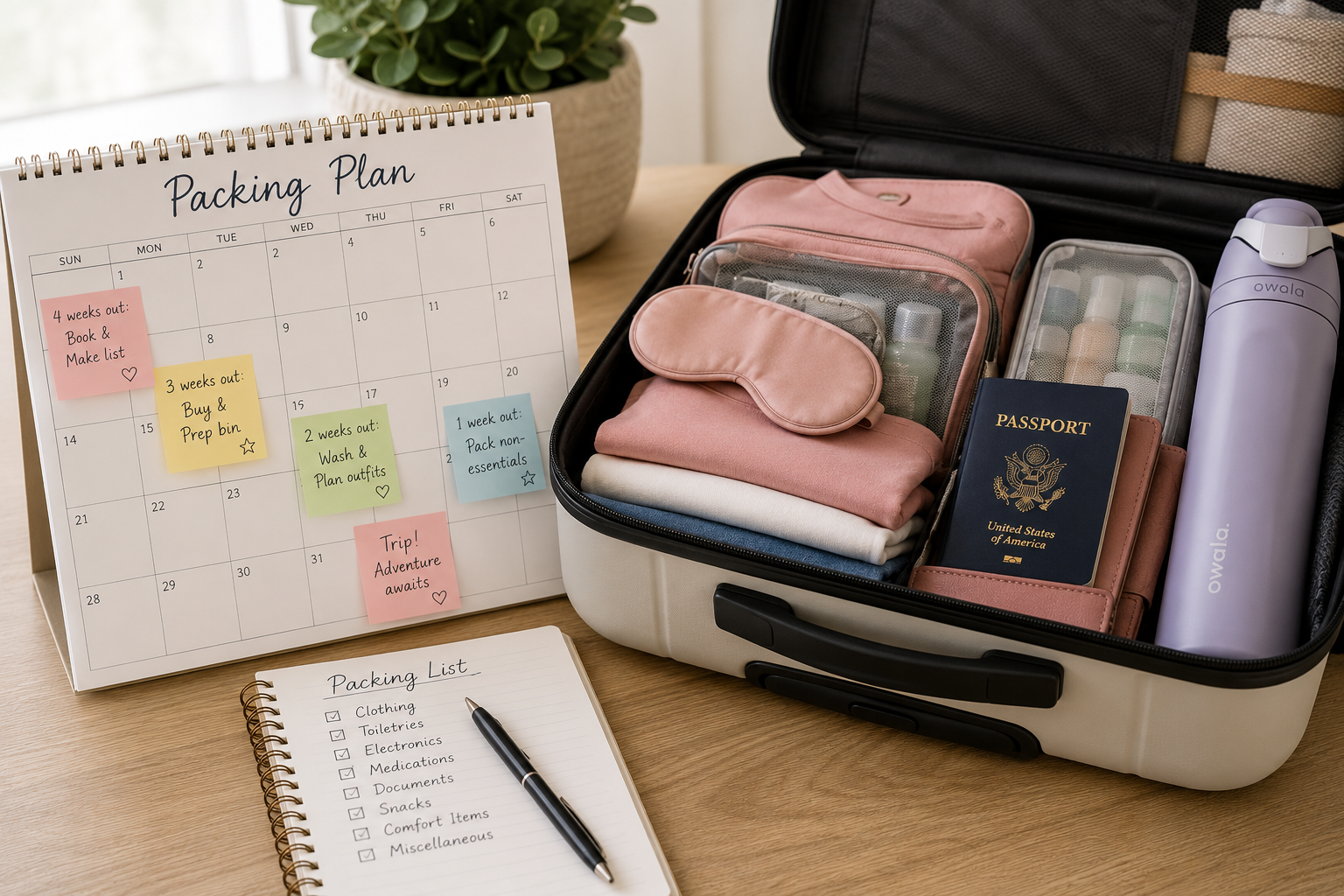
    Packing gradually in the weeks before a trip

    Four Weeks Before: The Big Stuff Should Already Be Locked In

    Honestly, most of my booking happens way earlier than four weeks out — flights especially, since that’s where the good prices live, and I’ve usually grabbed those two or three months ahead. But if I’m being realistic about a minimum, everything major is booked no later than about three weeks before I leave:

    • Flights
    • Hotels
    • Tours and activities
    • Rental car
    • Travel insurance

    By the four-week mark I want all of that done, so the countdown is about preparing — not scrambling to make decisions.

    Make a Packing List (by Category, Not Chaos)

    I don’t write one long random list — that’s exactly how things slip through. I break it into categories so my brain has somewhere to put each item:

    • Clothing
    • Toiletries
    • Electronics
    • Medications
    • Plane essentials
    • Camera gear
    • Documents

    Once the categories exist, I just fill them in over the next few weeks as things occur to me.

    Three Weeks Before: Start Buying What’s Missing

    This is when I start ordering the little things I know I’m out of or low on:

    • Sunscreen
    • Travel-sized bottles
    • Electrolytes (a non-negotiable for me — more on why in a second)
    • Protein bars and safe snacks
    • New walking shoes, if the old pair is done
    • Compression socks for the flight

    A quick honest aside: I have IBS, and I don’t drink coffee, so I’ve learned the hard way not to count on whatever’s being served in the air. There was a flight to Scotland where the plane food and I did not get along, and I spent the descent regretting every decision that led me there. Now I always travel with snacks I know my stomach is fine with, plus electrolytes, so a long travel day doesn’t wreck me.

    Spreading these purchases over a few weeks also just feels better. Buying everything the week before means one brutal few-hundred-dollar order all at once. Doing it gradually barely registers.

    Create a Travel Bin

    This is probably my favorite habit on the whole list. I grab one basket or tote and it becomes the landing spot for everything trip-related. As items arrive or turn up around the house, they go straight in:

    Nothing gets scattered across three rooms. When it’s finally time to pack, it’s all in one place. A small electronics organizer lives in there too, which keeps the cable spaghetti under control.

    Two Weeks Before: Laundry and Prescriptions

    Wash Everything You Want to Bring

    Nothing derails a packing list like realizing your favorite travel shirt is sitting damp at the bottom of the hamper. Two weeks out, I run whatever I’m planning to take through the wash so it’s clean, dry, and ready to go.

    Refill Medications

    This one matters more the longer you’ll be gone. I check every prescription and refill anything I’d run out of mid-trip — because sorting that out from another time zone is a headache I’ve earned once and don’t need again. A simple travel pill organizer keeps everything sorted by day.

    One Week Before: Start Packing the Non-Essentials

    Now the actual packing starts — but only the things I won’t touch before I leave:

    • Swimsuits
    • Jackets and a rain jacket
    • Chargers I don’t use daily
    • Packing cubes, loaded and ready

    Packing cubes are the thing I’d hand to past-me first. They turn a chaotic suitcase into tidy little compartments, and I can pull out a whole “category” without excavating everything else. I keep a travel laundry bag tucked in one of them for dirty clothes on the way home. And if you wind up somewhere without one — a hotel stay, say — one of the hotel laundry service bags or even a spare trash bag does the job just fine.

    Double-Check Every Reservation

    A week out, I go back through and confirm:

    • Flights
    • Hotels
    • Tours
    • Airport transfers and transportation

    Better to catch a wrong date now than at a check-in desk.

    Three Days Before: The Big Pack

    This is when the suitcase really fills up:

    • Most of my clothing
    • Toiletries I won’t need in the next few days (my hanging toiletry bag makes this painless)
    • Electronics I’m not using daily

    I also weigh the bag with a luggage scale at this point, so an overweight fee is never a surprise at the counter.

    The Night Before: Almost Nothing Left

    If I’ve done the earlier steps, the night before is calm. Only the daily-use stuff is still out:

    • Toothbrush
    • Phone charger
    • Whatever I’ll actually use in the morning

    I toss those in, and I’m done. No midnight closet raid. (Jasper and Nugget are always very invested in supervising this part — Nugget in particular considers the open suitcase her personal property.)

    My Travel-Morning Checklist

    Right before I walk out the door, I run one final check. These are the things that actually ruin a trip if they go missing:

    That airplane pouch is its own small ritual — snacks, electrolytes, headphones, a charger, and yes, an extra pair of undies. That last one sounds silly until a delay, a spill, or a rough travel day makes you deeply grateful they’re in your day bag and not in a checked suitcase somewhere over the Atlantic.

    Since I don’t drink coffee, water is basically my entire hydration strategy on a travel day — so my Owala FreeSip water bottle comes with me everywhere. I fill it right after security and sip the whole flight; the flip-top straw lid means I’m not wrestling a cap open over a tray table.

    I also keep an AirTag or Tile tracker in my checked bag, so if it decides to wander off, I at least know where it went.

    Why I Pack Early

    Packing early buys me:

    • Less stress
    • Fewer forgotten items
    • Time to actually replace anything missing
    • Better budgeting, spread over weeks instead of one panic-spend
    • More excitement leading up to the trip

    That last one is the real payoff. Instead of dreading the night before, I get to feel the good kind of pre-trip buzz — the anticipation, not the scramble. The suitcase never lives open in my room for a month, but the trip lives happily in the back of my mind the whole time.

  • 5 Things I’ve Stopped Packing — And Honestly Don’t Miss

    5 Things I’ve Stopped Packing — And Honestly Don’t Miss

    This post contains affiliate links. If you purchase through a link, I may earn a small commission at no extra cost to you. Full disclosure here.

    When I first started traveling regularly, I packed for every possible scenario.

    What if it rained? What if I needed a fancy outfit? What if I suddenly wanted to work out every day? What if my hotel didn’t have basic toiletries?

    The result was a suitcase I could barely lift, a sore shoulder from the airport, and a bag full of items that made the whole trip and never got touched.

    Over the years I’ve gotten a lot more honest with myself about what I actually reach for. These are five things I’ve stopped packing — and I genuinely don’t miss any of them.

    5 things I used to pack but don’t anymore — infographic

    1. Multiple “Just In Case” Outfits

    I used to add outfits to my bag for situations that existed entirely in my imagination. An extra dinner outfit in case somewhere nicer came up. An extra sightseeing outfit because what if the first one got dirty. An extra travel outfit as a backup for the backup.

    None of these scenarios ever justified the space they took.

    What changed it: I started being deliberate about packing pieces that actually work together instead of bringing a collection of options. The ANRABESS Keyhole Neck Travel Tee is a good example of what I mean — it looks put together enough to wear at dinner, comfortable enough to wear all day walking, and doesn’t wrinkle when packed. That’s one item doing the work of three, which is the whole idea.

    BAGSMART Compression Packing Cubes also helped here, counterintuitively. When you can see exactly how much space your clothes take up — and compress them down — it becomes obvious how much you were overpacking. There’s something about packing cubes that makes the “just in case” outfits feel genuinely unnecessary.


    2. Full-Size Toiletries

    I convinced myself I needed my exact products in their full-size containers. My specific shampoo. My preferred conditioner. The body wash I use at home.

    The reality: I used maybe a quarter of each bottle and lugged the rest through four countries.

    The switch that actually worked wasn’t buying a bunch of tiny containers and decanting everything (I tried that and it’s annoying). It was getting a proper hanging toiletry bag that made travel-size products feel organized rather than chaotic. The BAGSMART Large Hanging Toiletry Bag has enough compartments that everything has a spot — and it hangs from a hook in any hotel bathroom, which means you’re not unpacking it onto a wet counter every single night.

    I also stopped stressing about having my exact products everywhere. Hotel basics exist. TSA-size versions of most things exist. The toiletry bag helps make the switch feel like an upgrade rather than a compromise.


    3. A Separate Pair of Pajamas for Every Night

    This one sounds small but adds up fast.

    Nobody is evaluating your sleepwear. Not your travel companions, not the hotel staff, not anyone. One comfortable set is genuinely enough for most trips — wash them if needed, or don’t, because you’re on vacation and no one is checking.

    I used to pack pajamas almost as a reflex, one pair per three nights. Now I pack one. The space it frees up is embarrassingly useful.


    4. My Regular Everyday Wallet

    My everyday wallet is thick. Cards I haven’t used in months, old receipts, a gas station loyalty card, library card, backup lip balm. It’s fine at home and genuinely terrible for travel.

    What I bring instead: the Coco Rossi RFID Passport Holder, which keeps my passport, two cards, and some cash all in one slim holder. RFID blocking matters more than I used to think — when you’re in crowded airports and train stations, your cards are closer to strangers than they ever are at home. Having everything in one organized place also means I’m not digging through a fat wallet at every checkout counter or border crossing.

    The rule I use: if I wouldn’t need it in an emergency, it doesn’t travel with me.


    5. Too Many Shoes

    This was my biggest packing mistake for years, and I think it’s the most common one overall.

    My former packing list: sneakers, sandals, flats, a nicer pair for evenings, and some variation of “just in case” shoes that covered whatever I’d missed. I routinely traveled with four or five pairs and wore two of them.

    Now I travel with two, sometimes one, and the standard I use is simple: if a shoe isn’t comfortable enough to walk several miles in, it stays home. A nice shoe that destroys your feet by noon is not actually useful anywhere.

    The REEF Neptune has become my warm-weather travel shoe because it goes from beach to casual dinner without looking like a sport sandal, and I can walk all day in it without thinking about my feet. For anything with unpredictable weather, the Sperry Saltwater Duck Boot is the one shoe that handles rain, cold, and looks decent enough for most situations — which means it earns its spot in the bag where three shoes used to go.


    The Thing These Five Have in Common

    None of them were bad ideas at the time. They all came from a genuinely reasonable place — wanting to be prepared, wanting to feel like myself while traveling, not wanting to be caught without something.

    But over enough trips, the pattern became clear: the stuff I stressed about not having almost never came up. And the stuff I actually used was a much shorter list than I thought.

    Packing less didn’t make trips harder. It made the whole thing noticeably easier — through airports, between hotels, on travel days when you’re already running on four hours of sleep and don’t need a heavy bag to deal with too.

    If you’re still packing for every possible scenario, try cutting one category this trip. You probably won’t miss it.


    As an Amazon Associate, I earn from qualifying purchases. See my full Affiliate Disclosure for details.

  • What I Actually Keep in My Airplane Essentials Pouch (And Why Each Item Earns Its Spot)

    What I Actually Keep in My Airplane Essentials Pouch (And Why Each Item Earns Its Spot)

    This post contains affiliate links. If you purchase through a link, I may earn a small commission at no extra cost to you. Full disclosure here.

    You know the moment. You’re 35,000 feet up, the cabin is dark, and everyone around you is finally asleep. Your eyes are burning from the recycled air and your lip balm is buried somewhere at the bottom of your bag. Rummaging through it while the whole cabin is quiet is a lot.

    That’s the moment that convinced me to start keeping a dedicated pouch.

    The idea is simple: everything you’ll actually use during a flight lives in one small bag that fits in the seat pocket or sits in your lap. You pull it out when you board. Everything else stays in your bag.

    I’ve been refining mine for a few years. Here’s what’s in it now, and honestly, why each thing is worth the space.

    25 things I keep in my airplane essentials pouch infographic

    The Comfort Items You’ll Actually Reach For

    These are the things that go from “optional” to “essential” the moment you need them and don’t have them.

    Hydration — Airplane cabins run at humidity levels well below what your body is used to, which means you land feeling drained before the trip even starts. I’ve been adding Liquid I.V. Hydration Multiplier to my water bottle right after boarding. One packet in a full water bottle and you’re actually hydrating rather than just drinking — it uses cellular transport technology to deliver water more efficiently than plain water alone. The Concord Grape flavor is surprisingly good and doesn’t taste artificial.

    Eye drops — If you wear contacts or spend the flight staring at a screen (guilty), dry cabin air hits your eyes fast. TheraTears Dry Eye Therapy drops are my go-to. They’re preservative-free, which matters if you’re using them more than once, and they actually feel like relief rather than just moisture. One small bottle takes up almost no space.

    Motion sickness — I don’t always need these, but turbulence is unpredictable — and buses, ferries, and mountain switchbacks definitely are. The MQ Motion Sickness Patches go behind the ear, are non-drowsy, and last up to 72 hours, which means one patch can cover your flight, an overnight transfer, and a bumpy boat ride the next day. Much easier than tracking a pill schedule during travel.

    Pain reliever, allergy medication, and any prescriptions — I keep small amounts in my pouch and always keep prescriptions in my personal item, never in checked luggage. A few ibuprofen and a dose of antihistamine have saved more trips than I can count.


    The Electronics That Actually Pull Their Weight

    Headphones — This is non-negotiable for me, and after too many years of buying cheaper pairs that cut out mid-flight, I finally invested in the Bose QuietComfort Headphones. The active noise cancellation alone is worth it — engine noise disappears, which makes sleeping, watching anything, or just sitting quietly an entirely different experience. They charge via USB-C, run up to 24 hours, and fold flat enough to live in the pouch without taking over it. If you fly regularly and you’re on the fence, this is the upgrade that actually changes how travel feels.

    Portable charger — Not every seat has a working outlet, and even when they do, you may not always have a long enough cord. I switched to the VEGER 5000mAh USB-C Power Bank because it charges at 20W — fast enough to actually matter — and it’s genuinely small, about the size of a deck of cards. 5000mAh gets most phones to 100% once or close to twice. It’s enough for a domestic flight and a layover without feeling like you’re carrying a brick.

    Short charging cable — A two-foot cable is enough and avoids the tangle situation entirely. I keep one coiled with my charger.


    Skin & Personal Care (The Stuff I Used to Skip and Now Never Do)

    Cabin air is rough on skin. Between the dryness, recycled air, and the fact that you’re touching surfaces and then touching your face more than you realize, travel days tend to show up on your skin within 24 hours.

    The item that actually changed this for me: Magic Molecule Hypochlorous Acid Spray. It sounds clinical, but hypochlorous acid is naturally produced by your immune system and is genuinely gentle — it calms irritation, helps with breakout-prone skin, and works on eczema and rashes too. I spray it on after settling in, after touching communal surfaces, and before applying any moisturizer mid-flight. It’s TSA-compliant and one of those finds I now can’t imagine traveling without.

    Lip balm — Cabin air dries your lips faster than almost anything else. Keep one accessible, not buried.

    Disinfecting wipes — I use one on the tray table, armrests, and seatbelt buckle before settling in.

    Hand sanitizer — After security, before snacks, after the lavatory. Travel days involve a lot of shared surfaces.

    Travel toothbrush and toothpaste — Essential for overnight flights and long layovers. Brushing before landing makes an outsized difference in how you feel when you arrive.

    Hair tie — You’ll think you don’t need it until you do.


    Snacks That Actually Hold You Over

    Travel delays are real. Airport food is expensive and not always available when you want it. I keep one or two snacks in the pouch so I’m never stuck and hungry.

    My current go-to is BUILT Bar Puff Protein Bars. They have 15–17g of protein with collagen, are gluten free, and — this matters — they actually taste good. The texture is lighter than a standard dense protein bar, which makes them easier to eat when you’re not particularly hungry but need to eat something. The variety pack means you’re not stuck eating the same flavor every trip.

    Trail mix is my backup because it doesn’t melt, crush, or expire fast. Electrolyte gummies are worth tossing in if you’re prone to travel fatigue.


    Sleep Essentials

    Eye mask — Especially helpful on red-eyes. I like the contoured kind that doesn’t press directly against your eyes.

    Earplugs — A lightweight backup for when headphones run out of battery.

    Compression socks — I keep these at the top of my bag rather than in the pouch itself and put them on right after boarding on longer flights. Your legs will thank you on landing.


    Documents

    I keep a small flat pocket at the back of the pouch for: passport (international), boarding pass backup, and a pen — still surprisingly necessary for customs forms.


    For Long-Haul Flights, I Add:

    • A small moisturizer or face oil to apply mid-flight
    • Face mist
    • Travel-sized deodorant
    • Mini lint roller
    • Empty reusable water bottle
    • N95 or preferred face mask

    What Makes a Good Airplane Pouch

    The pouch itself matters more than I initially thought. You want one that opens fully flat so you can see everything, has a bright-colored interior, has a sturdy zipper that opens one-handed, and is slim enough to fit in a seat back pocket or sit on your lap without becoming bulky.

    The goal is simple: once you’re in your seat, you pull out one pouch, set it on your lap or in the seat pocket, and you have everything you’ll need for the next several hours. No rummaging. No standing up. No waking up the person in the aisle seat.

    It’s a small habit that makes travel noticeably less stressful — and once you’ve done a few flights with one, you’ll wonder how you managed without it.


    As an Amazon Associate, I earn from qualifying purchases. See my full Affiliate Disclosure for details.

  • What I’m Packing for 12 Days in Europe: Carry-On Only

    What I’m Packing for 12 Days in Europe: Carry-On Only

    This post contains affiliate links. If you purchase through a link, I may earn a small commission at no extra cost to you. Full disclosure here. Updated post-trip with what I actually packed, what worked, and the one packing curveball I did not see coming.

    Here’s what I did: twelve days across five countries, with a carry-on suitcase only.

    Belgium. Luxembourg. Germany. France. Switzerland. One bag. No checked luggage, no checked fees, no waiting at baggage claim after an overnight transatlantic flight when I landed in the morning and desperately wanted to get to the hotel and lie down.

    I’ve been working toward carry-on only travel for a while now. The packing cubes made it feel possible. The right bag made it feel achievable. This trip was the real test: longer than I’d done carry-on before, more weather variability than a short weekend, and enough moving between cities that I couldn’t afford to be dragging an overweight bag through cobblestone streets in July heat.

    This is what I actually packed, why it earned its spot, and what I left at home on purpose — plus the one packing curveball I didn’t see coming. Full post-trip verdict below.


    🗺️ The Trip

    Twelve days, five countries, all in summer — a mix of big cities, small towns, and one mountain day, moving every few days rather than living out of a suitcase in one spot. That pacing helps a lot with carry-on only, because you’re not fully unpacking and repacking at every stop.

    The full day-by-day itinerary — where we went, in what order, and how we got between stops — is getting its own post. This one’s just about what went in the bag.


    🎒 The Bag Situation

    I ended up sticking with the same BAGSMART 35L Travel Backpack I used for Oregon, instead of upgrading to something new — and I’m glad I did. It held everything I needed for twelve days across five countries, the pockets made grabbing quick-need items (passport, phone, chargers) genuinely easy, and it was simple to manage moving between cities. It did get a little warm against my back at one point, but nothing dramatic — and I run hot regardless of what I’m wearing, so I wouldn’t hold that against the bag.

    Confession: I packed everything to true carry-on spec — I confirmed it all fit in my actual carry-on before I left. But two weeks before the trip, that carry-on cracked from years of use, and I didn’t have time to find a replacement I loved (I’ve got my eye on a Samsonite for next time). So I traveled with a bag one size up, out of necessity, not choice. Everything on this list still fits in a genuine carry-on — I checked.

    Inside the bag: the same BAGSMART Compression Packing Cubes I’ve used on every trip since I found them. Compression cubes are genuinely the single biggest reason carry-on only was achievable for a trip this long — not because they create space from nothing, but because they forced me to be intentional about what went in, and they kept everything from becoming one large tangled pile. The BAGSMART Large Hanging Toiletry Bag handled everything in the bathroom, hung from any hook, and meant I never had a shampoo bottle loose in my bag.


    👚 What I Actually Packed

    July in this part of Europe was warm — high 70s to low 80s — with enough afternoon rain that waterproofing mattered. The activities were almost entirely city walking, which meant cobblestones, uneven surfaces, and a lot of standing. One mountain (Rigi), which added a layer consideration for elevation. No beach. No formal events.

    Clothing

    Here’s the actual list, no rounding down: 4 pairs of shorts, 1 long skirt, 1 short skirt, 2 pairs of flowy pants (black and tan), 6 t-shirts (2 black, 2 white, 1 grey, 1 maroon), 1 tank top, 4 bras, 6 pairs of socks, 1 pair of pajamas, and 14 pairs of underwear — yes, fourteen. We do what we must. I did one load of laundry mid-trip, Tide packets in the sink, mainly to refresh the t-shirts.

    All of that still left room on the way back for souvenirs — I bought two shirts and packed them straight into the backpack — plus my French pharmacy haul (its own post, coming soon) and a stash of chocolate. Everything fit without a fight.

    Shoes

    Shoes are the hardest part of packing for Europe, and the cobblestone streets will destroy anything without proper support. I packed two pairs and wore a third: the Skechers GO Walk Flex slip-in sandals and the REEF Neptune went in the bag, and the New Balance 1080 v15 went on my feet to the airport. Wearing a pair on the plane instead of packing it is still non-negotiable with carry-on only travel.

    The split wasn’t quite what I expected, though. The sandals did more work than either sneaker — they were simply more comfortable for the sheer amount of walking, and they’re a cute enough open-toed shoe that I never felt underdressed in them. The sneakers came out on cooler days and for the mountain. Worth remembering for next time: pack the shoe you’ll actually reach for, not just the one that photographs best.

    Day Bag

    The Baggallini Securtex Anti-Theft Daytripper Sling came everywhere as my day-use bag — same as it did in Seattle. It held what I actually needed for a day of city walking: phone, wallet, passport holder, earbuds, lip balm, one snack. Didn’t require thinking about. Didn’t pull on one shoulder. Fit under a seat on a train without blocking the aisle.

    Rain

    The SY COMPACT Travel Umbrella came along, and it earned its space — European summer weather was genuinely unpredictable, and I wasn’t caught out without one this time.


    🛩️ The Flight Kit

    Transatlantic overnight flight. I do not sleep well on planes. I wore a sweater, a t-shirt, and joggers for the flight over — comfortable enough to sleep in, and easy to wash and re-wear for the flight home. Here’s what else was in my personal item for the flight specifically:


    📊 Documents + Security

    Baggallini anti-theft sling bag, floral RFID passport holder, luggage tag, and US passport laid out on a bed

    Five countries meant five opportunities to need my passport in a hurry. Everything document-related traveled in the Coco Rossi RFID Passport Holder, which fit into the Baggallini sling and meant I always knew exactly where it was. Anikathy Luggage Tags on the bag, Life360 Tile Slim inside it. The bag never got lost — carry-on only makes that substantially less likely — but I would have had a way to find it.


    📝 What I Actually Left at Home

    This is the part of carry-on only packing that nobody talks about honestly enough — and all of it held up.

    • The “just in case” outfit. I packed for the trip I was taking, not for an imaginary nicer version of it. No specific occasion on the itinerary meant no outfit for it — and I didn’t miss it once.
    • Full-size anything. Every toiletry was travel-size or solid-form. The hanging toiletry bag never got heavy enough to strain the hook.
    • The second pair of pajamas. One set was genuinely enough — I shower before bed, so I never needed a backup. Though in hindsight, I could have fit a second pair, or done a laundry run first thing in the morning if I’d wanted the option.
    • Books. Kindle app exists. I didn’t carry three paperbacks across Switzerland just in case I wanted options.
    • Anything I could buy there. Forgot something? If it cost less than the airline’s checked bag fee, I bought it at a pharmacy instead — more on that haul soon.

    ✅ The Verdict

    Carry-on only worked — even with a last-minute bag swap I didn’t plan for. Everything on this list fit, nothing felt like a sacrifice, and the one hiccup (RIP, old carry-on) turned into a lesson for next time rather than a disaster. The full day-by-day breakdown of where we went is coming in its own post.


    Related Reading

    As an Amazon Associate, I earn from qualifying purchases. See my full Affiliate Disclosure for details.